How to Evaluate a Virtual Furniture Photography Studio: A 2026 Buyer's Framework
A 7-criterion buyer's framework furniture brands can use to evaluate any virtual photography studio in 2026 — covering quality, workflow, throughput and unit economics.
Choosing a virtual furniture photography studio in 2026 is not a creative decision — it is a procurement decision with downstream impact on conversion, margin and time-to-market. This guide gives furniture operators a seven-criterion evaluation framework that works for any vendor, from single-image render houses to platform-based approaches like Furniture Connect. Use it to score shortlisted providers, run a structured pilot, and avoid the most common buyer mistakes.
What is virtual furniture photography, and why does evaluation matter now?
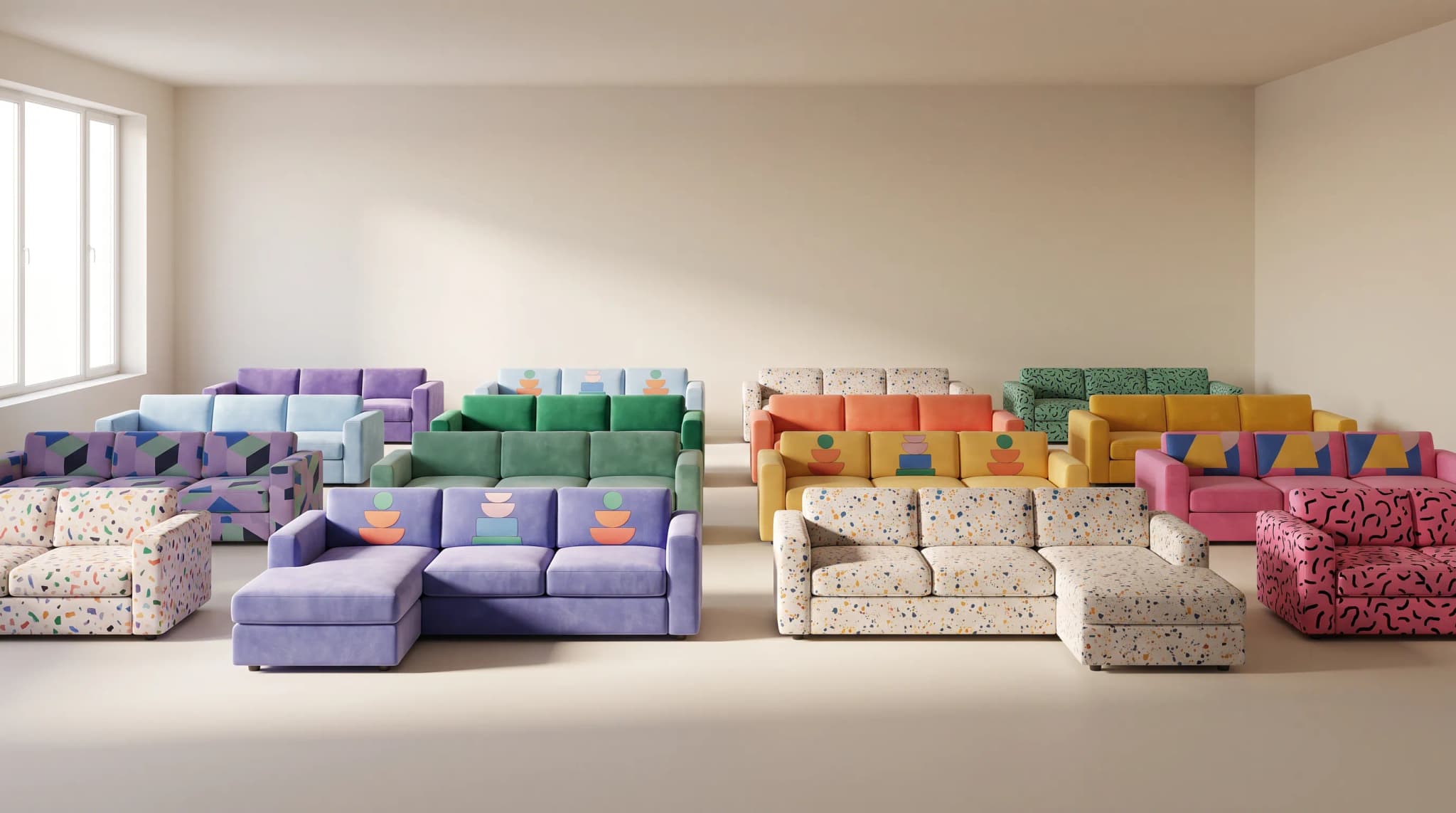
Virtual furniture photography is the creation of product and lifestyle imagery using 3D rendering, AI image generation, or a hybrid of the two, in place of — or alongside — a physical photoshoot. Outputs include white-background pack shots, room scenes, fabric and finish variants, 360-degree spins and short product videos. Because no physical sample is required, variants are cheap and imagery can ship before manufacturing finishes.
The category matured fast. Statista's furniture e-commerce outlook projects global online furniture revenue to surpass $300B by 2027, and Furniture Today reports the online share of retail furniture has roughly doubled since 2019. McKinsey's retail research keeps reinforcing the same point: product imagery is one of the strongest drivers of conversion, returns and average order value in home categories.
That growth has created a crowded supply side. Dozens of virtual photography studios, render houses and single-image CGI vendors now pitch furniture brands. They look superficially similar in a sales deck — beautiful hero shots, vague throughput claims, opaque pricing. The differences only appear once you try to run a real catalog through them. AI visual-production tools for product imagery, such as Presti, are part of that field too; see our Presti alternative for furniture comparison.
A structured evaluation matters because the wrong pick is expensive in three ways: rework cost when output misses brand, hidden integration cost when files do not flow into your PIM and channels, and opportunity cost when slow turnaround delays launches. The framework below is designed to surface all three before you sign.
The 7 criteria furniture brands should evaluate
These seven criteria are what category leads at mid-market and enterprise furniture brands actually weigh when shortlisting a virtual studio. Score each vendor 1–5, weight by what matters to your business, and let the totals — not the hero reel — drive the decision.
| # | Criterion | What you are really measuring |
|---|---|---|
| 1 | Output quality at catalog scale | Consistency across 500+ SKUs, not 5 hero shots |
| 2 | Brand consistency across variants | Identical lighting, framing and styling per family |
| 3 | Workflow integration | PIM, DAM and channel delivery without manual ops |
| 4 | Turnaround and throughput | Hours per image and images per week at peak |
| 5 | Iterative refinement | How fast and cheap a second round is |
| 6 | Material and proportion fidelity | Fabric, wood grain, metals and human-scale accuracy |
| 7 | Total cost of ownership | Fully-loaded cost per usable image, not list price |
The rest of this guide unpacks each criterion with what to ask for, what good looks like, and the red flag that should disqualify a vendor.
Criterion 1: Output quality at catalog scale (not just hero shots)
Every vendor can produce one stunning image. The real question is what their 200th image of the season looks like when the team is tired and the brief is ambiguous. Ask any shortlisted studio for an unfiltered sample of 50–100 consecutive images from a real client catalog — not a curated portfolio.
What good looks like: lighting that holds across an entire product family, no visible AI artefacts in fabric weaves or wood grain, no warped legs or hovering cushions, and human-scale props that read correctly. Our deep dive on the uncanny valley problem in furniture renders covers the specific tells that operators learn to spot.
| Required output | Red flag if absent |
|---|---|
| 50+ consecutive catalog samples | Vendor only shows a hero reel |
| Pack shot + lifestyle in same family | Lifestyle shots from different vendor than pack shots |
| Variant images at full resolution | Watermarked or downsampled samples |
| Recent work (last 90 days) | Portfolio older than 12 months |
Criterion 2: Brand consistency across SKUs and variants
A catalog is a system, not a collection of images. The same sofa in 40 fabrics needs identical camera angle, lighting and styling — otherwise PDPs feel chaotic and conversion drops. Single-image render houses and freelance CGI vendors typically fail this test because each artist re-interprets the brief.
Ask each vendor how they enforce consistency. Acceptable answers reference scene templates, locked camera rigs, style guides applied programmatically, or a refinement layer that normalises output. Unacceptable answers are "our artists are very experienced" or "we follow the brief carefully." The anatomy of a perfect product listing explains why this consistency compounds across a PDP.
Platform-based approaches — including Furniture Connect — typically handle this with a furniture-specific workflow that locks scene parameters per product family, so variants inherit identical setup. Ask to see two products from the same family shot weeks apart.
Criterion 3: Workflow integration — PIM, DAM, and channel delivery
This is where most evaluations go wrong. Buyers fixate on image quality and ignore the operational tax of getting those images into the catalog. A studio that delivers a Dropbox folder of PNGs is creating work for your e-commerce team, not removing it.
Ask each vendor:
- Do you push directly into our PIM or require manual upload?
- Do renamed and re-versioned files flow through to our DAM?
- Can you deliver channel-specific crops and formats (Amazon, Shopify, Wayfair, retail partners) automatically?
- How do you handle SKU updates when a fabric is discontinued?
Shopify Plus and BigCommerce both publish image spec requirements per channel — your vendor should know them. Google Search Central's image SEO guidance adds another layer: file naming, alt-text-ready metadata, and structured data hooks.
The red flag here is any vendor who treats integration as "out of scope" or quotes it as a separate professional services engagement. At catalog scale, the integration is the product.
Criterion 4: Turnaround and throughput economics
Two numbers matter: turnaround per image (hours from brief to first delivery) and weekly throughput at peak (how many images you can ship in the busiest week of a launch). Vendors will quote average turnaround. You want the 90th percentile.
A pure render-house model usually delivers 5–10 business days per image because each render is a small project. AI-native studios collapse that to hours or minutes, but throughput depends on how much human review sits in the pipeline. Hybrid platforms tend to sit in between, with the upside of consistent output.
| Metric | Mid-market target | Enterprise target |
|---|---|---|
| First-draft turnaround | < 48 hours | < 24 hours |
| Revision turnaround | < 24 hours | < 8 hours |
| Weekly throughput at peak | 200+ images | 1,000+ images |
| SLA on misses | Credit or rework | Credit + escalation path |
Run the maths against your launch calendar. A vendor that cannot clear your busiest week is not a vendor — they are a bottleneck. Our guide to product staging covers how throughput intersects with creative direction.
Criterion 5: Iterative refinement and editorial control
First drafts are rarely final. The cost and speed of round two is where vendors quietly diverge. A single-image CGI vendor typically charges for revisions and treats them as new projects. A good platform treats refinement as a first-class workflow — masked edits, prompt-level adjustments, swap-in alternate fabrics, restage a scene — without restarting from zero.
Ask to see the refinement interface, not just the output. Who can request changes? Does it require a producer email, or can a merchandiser self-serve? How are revisions versioned and approved? Is there an audit trail for compliance or wholesale partners?
Furniture Connect, for example, exposes refinement as a direct merchandiser action inside the platform, so a category manager can adjust a render without routing through an external producer. Whatever vendor you evaluate, the question is the same: can the person closest to the product also change the image?
Criterion 6: Material and proportion fidelity
Furniture is unforgiving. A 5 percent error in seat depth or a fabric that reads as plastic instead of bouclé will kill conversion and drive returns. Material fidelity is where many AI-only image vendors fail and where 3D-only render houses excel — but render houses pay for that fidelity in time and money.
The evaluation question: how does the vendor source material truth? Acceptable inputs include CAD files, factory drawings, scanned fabric swatches, or a library of pre-validated materials. Unacceptable is "we generate plausible materials from the brief."
Proportion fidelity is the same test on geometry. Ask for a render of a known product where you can measure pixel ratios against the spec sheet. Anything more than 2–3 percent off on key dimensions (seat height, arm depth, overall width) is a fail. Platforms using a mix of underlying AI models with intelligent routing and a furniture-specific refinement layer can typically anchor proportions to spec data rather than letting the generative model improvise.
Criterion 7: Total cost of ownership and unit economics
List price is the least interesting number in the proposal. Total cost of ownership has six components:
- Per-image production cost
- Revision and rework cost (often 20–40 percent of round one)
- Integration and operational cost (your team's time)
- Channel-formatting cost (crops, resizes, alt-text prep)
- Storage and DAM cost
- Opportunity cost of slow turnaround
Build a fully-loaded cost-per-usable-image number for each vendor across a realistic 12-month catalog. Our savings calculator walks through this maths against traditional photography, and our pricing page shows how a platform-based model bundles production, refinement, integration and DAM into one number — which is a different shape from per-render pricing.
The general pattern: render houses look cheap on hero shots and expensive at catalog scale. AI-only tools look cheap everywhere until you count rework and integration. Platforms look more expensive per image but lower per usable image once integration and refinement are included. Run the maths, do not trust the deck.
Use the AI image-platform evaluation checklist to include integration, revision effort and governance in the same trial as image quality.
How to run a 30-day evaluation pilot
A pilot is the only honest test. Sales demos are theatre. Here is a 30-day structure that surfaces real signal:
Week 1 — Brief and onboarding. Hand each vendor the same brief: 20 SKUs across 2 product families, including at least one fabric-heavy and one wood-heavy item. Provide the same CAD or reference inputs to each. Track onboarding friction — every email exchange is a tax you will pay forever.
Week 2 — First-draft delivery. Score against criteria 1, 2 and 6 (quality, consistency, fidelity). Record first-draft turnaround. Have three internal reviewers — merchandising, creative, e-commerce ops — score independently to remove personal preference bias.
Week 3 — Revisions and integration. Submit identical revision requests to each vendor. Score against criteria 3 and 5 (workflow, refinement). Attempt a full integration into your PIM and at least one sales channel. Time every manual step.
Week 4 — Peak simulation and TCO. Push each vendor to a small peak load — say, 50 additional SKUs in five business days. Score against criterion 4 (throughput). Then build the fully-loaded TCO model for criterion 7. Pull the case studies and references for the finalists and call two customers each.
At the end, you have a scorecard, not an opinion. If you want a structured pilot template, request a demo and we can share the one our customers use.
Common evaluation mistakes and how to avoid them
Mistake 1: Evaluating on hero shots. Hero shots are the vendor's portfolio piece. Insist on consecutive catalog samples.
Mistake 2: Ignoring the integration tax. A 20-cent-per-image difference is dwarfed by 10 hours per week of manual file handling. Score workflow as hard as you score quality.
Mistake 3: Trusting average turnaround. Averages hide tail risk. Ask for 90th-percentile turnaround and SLA terms in writing.
Mistake 4: Letting creative veto procurement. Creative teams will favour the studio with the prettiest reel. Operators should weight consistency, throughput and integration at least as heavily as raw aesthetics — because at catalog scale, those drive the P&L.
Mistake 5: Buying tools instead of outcomes. A single-image generator is a tool. A render house is a service. A platform is an operating model. The right question is not "which is best" but "which matches how we want to run the category." Most mid-market and enterprise furniture brands eventually move to a platform model because tools and services do not scale linearly with catalog size.
Mistake 6: Skipping the pilot. Vendors who refuse a structured pilot or charge enterprise rates for one are telling you something. Walk.
The seven criteria above will not pick the vendor for you — they will force the vendor selection to be defensible, comparable and aligned to operational reality. That is the entire job of a buyer's framework. Apply it consistently and the right choice surfaces on its own.
Frequently asked questions
What is virtual furniture photography?
It is product and lifestyle imagery created with 3D rendering, AI image generation or a hybrid of both, in place of or alongside a physical photoshoot. Outputs include white-background pack shots, room scenes, fabric and finish variants, 360-degree spins and short product videos. Because no physical sample is needed, variants are cheap and imagery can ship before manufacturing finishes. The supply side is crowded, so vendors look alike in a sales deck and only separate once you run a real catalog through them.
What should furniture brands evaluate when choosing a virtual photography studio?
Seven criteria, scored one to five and weighted for your business: output quality across 500-plus SKUs rather than five hero shots, brand consistency across variants, workflow integration with PIM, DAM and channels, turnaround and peak throughput, cost and speed of iterative refinement, material and proportion fidelity, and total cost of ownership per usable image. Ask each vendor for 50 to 100 consecutive images from a real client catalog, not a curated portfolio, and let the totals drive the decision.
How long should a virtual furniture photography vendor take to deliver images?
Ask for 90th-percentile turnaround, not the average. A pure render house usually needs five to 10 business days per image because each render is a small project; AI-native studios collapse that to hours or minutes, depending on how much human review sits in the pipeline. Reasonable targets: a first draft inside 48 hours for mid-market and 24 for enterprise, revisions inside 24 hours or eight for enterprise, and peak weekly throughput of 200-plus or 1,000-plus images. A vendor that can't clear your busiest week is a bottleneck.
How do I compare the real cost of virtual photography vendors?
Build a fully loaded cost per usable image across a realistic 12-month catalog. List price is one of six components; the others are revision and rework (often 20 to 40 percent of round one), your team's integration and operational time, channel formatting such as crops and alt-text prep, storage and DAM, and the opportunity cost of slow turnaround. Render houses look cheap on hero shots and expensive at scale; AI-only tools look cheap until you count rework; platforms cost more per image and less per usable image.