CGI vs Photography for Furniture: When Each Wins on Cost and Quality (2026)
A 2026 decision framework for furniture catalog imagery: when photography, traditional CGI, and AI imagery each win on cost, time, and brand fit.
For most of the last decade, the furniture catalog imagery decision was binary: photograph the SKU, or commission a CGI render. In 2026 there is a third lane — AI imagery — and the cost, quality, and time profile of every option has shifted. This guide is a practical framework for picking the right method per SKU and per surface. Furniture Connect sits inside the AI imagery and AI 3D space, but the framework below is method-agnostic.
Why this decision needs a 2026 reframe
The old logic — "CGI for variants, photography for hero shots" — was correct for a long time. It assumed two things that no longer hold: that CGI required a multi-week pipeline before a single image came out, and that anything generated by software looked obviously generated, so high-trust surfaces had to be photography.
Both assumptions have moved. The bigger shift is the arrival of furniture-specific AI imagery workflows that produce catalog-grade output in minutes from a single product photo or 3D source. The decision is no longer "render or shoot." It is "which of three methods earns this SKU, this surface, and this stage of the buyer journey." The Baymard Institute's product page UX research keeps surfacing the same point: image quality is a top-three driver of B2B and D2C conversion, and method matters less than fit.
Three production methods, not two: photography, traditional CGI, AI imagery
Before the framework, the three lanes need precise definitions. They are not interchangeable.
- Traditional photography. A physical sample, a studio or location, a photographer, lighting, styling, and post-production. Output is one set of images of one physical configuration. Time-to-first-image is days to weeks once the sample exists.
- Traditional CGI. A 3D artist builds a 3D model of the product, assigns materials, places it in a virtual scene, lights it, and renders. Output is unlimited camera angles, variants, and room sets — once the model exists. Time-to-first-image is days to weeks; revisions are fast once assets are built.
- AI imagery. A software workflow that takes existing inputs — a product photo, a 3D model, a CAD file, or a swatch — and generates new catalog images in minutes. Modern AI imagery platforms use a mix of underlying AI models with intelligent routing. Output quality depends heavily on input fidelity and workflow controls.
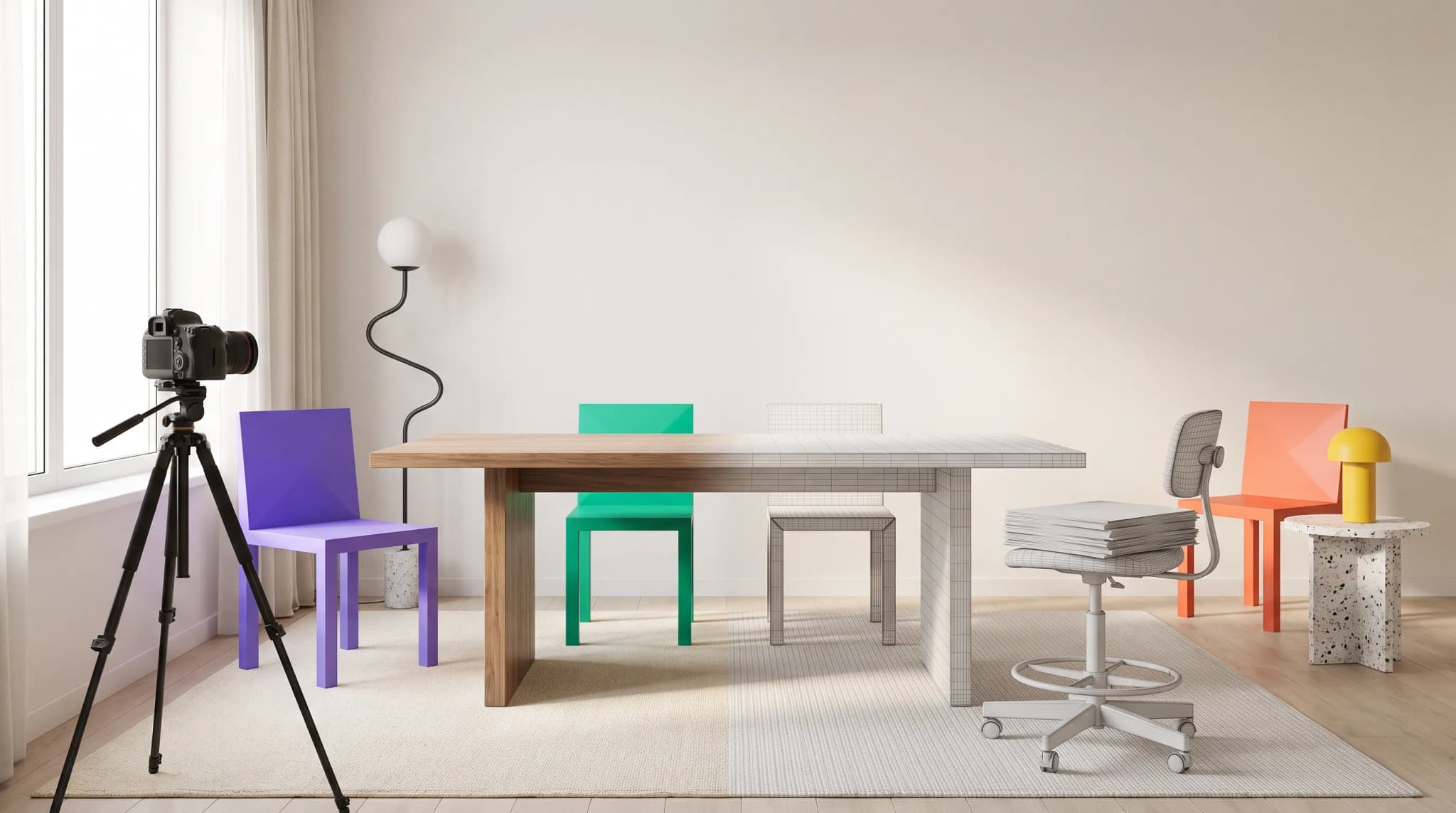
A useful way to read the rest of this article: photography captures reality, traditional CGI rebuilds reality, and AI imagery transforms reality.
Where photography wins
Photography wins whenever the product itself is the evidence. There are four situations where nothing else is a serious option.
Material-defining SKUs. Solid wood with visible grain. Marble with veining. Aniline leather. Natural rattan. The selling point is the natural variation, and buyers know it. AI imagery and CGI both tend to homogenize these textures. Shoot the actual piece.
High-value contract decisions. When a hospitality group is specifying 600 chairs for a refit, the imagery underwriting that commitment should represent what arrives on the loading dock. The marginal cost of a shoot is trivial relative to the cost of a dispute. Furniture Today's contract reporting repeatedly highlights returns and chargebacks as the silent margin killer — accurate imagery is part of the procurement contract, not just marketing.
Craft- and provenance-led brands. If your brand story is workshop-made or hand-finished, AI imagery and CGI both risk undercutting the positioning. Hero imagery should match the manufacturing story.
Editorial and brand campaigns. Some images do not exist to sell a SKU — they set the tone for a season or a flagship space. A talented photographer with a stylist and a real environment still produces a kind of image that is hard to fake convincingly.
If the answer to "would a buyer feel misled if this image were generated?" is yes, the answer is photography.
Where traditional CGI wins
Traditional CGI wins when you need pixel-precise control over geometry, when variant counts are extreme, and when the product is not yet built.
Engineered and modular systems. Office systems, kitchens, modular sofas, shelving with hundreds of permutations. The economics of photography collapse around SKU 30; CGI scales flat. Once the parametric 3D model exists, variants are configuration changes, not new shoots.
Pre-launch and pre-production. If the product does not physically exist yet, photography is not an option. CGI is the established way to produce trade-show materials, pre-order pages, and dealer sell-in decks before the first sample arrives.
Technical and AR/VR surfaces. Dealer configurators, AR previews, and VR showrooms need accurate 3D geometry, not pixels. If you already have to build the 3D asset for AR, the CGI renders are a low-marginal-cost byproduct. The Khronos Group's glTF specification is the practical standard for these assets across web, AR, and engine pipelines.
Brand-controlled scene libraries. When the same room sets need to appear across hundreds of products with bit-exact consistency — same lamp, same wall paint, same camera angle — pre-built CGI scenes are still the cleanest way to get there.
The trade-off is up-front cost and time. A studio-grade 3D model built from scratch with PBR materials typically takes a 3D artist days to weeks. The math is good at scale, but the entry ticket is real. Managed services such as Rendify take on that modeling and rendering work from your CAD and reference files; see managed CGI versus Furniture Connect for how the two approaches differ.
Where AI imagery wins
AI imagery wins on time-to-first-image, on cost per SKU, and on long-tail variants and lifestyle contexts where traditional CGI would be over-engineered.
Variant explosion. Show a sofa in 24 fabrics across 6 room sets. Shooting it is uneconomic; rebuilding it in CGI is overkill if you already have a real photograph. AI imagery extends an existing photograph across variants in minutes, with consistent lighting and camera.
Room sets and lifestyle. Photography wins for editorial hero, but the long tail of "this credenza in a Brooklyn loft, a Tokyo apartment, a Cotswolds farmhouse" is what AI imagery is built for. Composite the real product into AI-generated environments and you keep accuracy where it matters.
Marketplace and dealer feeds. B2B sales apps, dealer portals, and marketplace listings all want the same product in subtly different formats — square crops, lifestyle context, white background. AI imagery is the cheapest way to fan one source asset out across surfaces. Shopify Plus B2B research and BigCommerce B2B benchmarks both report converging image expectations between B2B and D2C.
Pre-launch tests and concept validation. Run a market test on three colorways before tooling. The McKinsey work on AI in retail and marketing finds that companies using AI to shorten creative cycles get more test-and-learn loops per quarter, not just cheaper images.
The risk with AI imagery is the uncanny valley on material-critical SKUs. The mitigation is a furniture-aware workflow that ties outputs back to the real product, not a horizontal text-to-image tool.
The cost comparison: per-image and total catalog economics
The headline numbers vary by market and supplier, but the shape of the per-image curve is consistent. Per-image cost is the wrong metric in isolation; total catalog cost across a refresh cycle is what matters.
| Method | Per-image (indicative) | Time to first image | Marginal cost of variants | Fixed setup cost |
|---|---|---|---|---|
| Traditional photography | High (studio + post) | Days to weeks | High (re-shoot) | Low |
| Traditional CGI | Medium-high (artist time) | Days to weeks | Low (once model exists) | High (3D + scenes) |
| AI imagery | Low | Minutes | Very low | Low |
A more useful way to frame it: photography is a per-SKU cost, traditional CGI is a fixed asset cost amortized across variants, and AI imagery compounds favorably as you generate more. The interactive savings calculator walks through this for a real SKU count and refresh cadence. The published pricing page covers commercial framing for B2B-scale catalog programs.
The other cost line is opportunity cost. Every week a new collection is not on the dealer portal is a week of missed orders. Methods that move time-to-first-image from weeks to minutes are not just cheaper — they change how often the catalog can refresh at all.
The quality comparison: realism, fidelity, brand consistency
Cost comparisons are easy. Quality comparisons need three separate axes — they often get conflated.
Realism. Does the image look like a photograph? Photography wins by definition. Modern AI imagery is closing the gap fast on most product categories; traditional CGI ranges from photorealistic to obviously rendered depending on the studio. Earlier coverage of this gap makes the case in more detail.
Fidelity to the actual SKU. Does the image match the product that arrives on the loading dock? Photography is structurally advantaged — the camera captures the real object. CGI is as faithful as the 3D model and materials allow. AI imagery is as faithful as the input asset; a workflow that starts from a real product photograph is dramatically more faithful than one that starts from a text prompt.
Brand consistency at scale. Same lighting, same camera height, same aspect ratios, across thousands of SKUs. Photography is the hardest to keep consistent because every shoot is a fresh production. CGI is the easiest if a scene library exists. AI imagery sits in the middle — consistency depends on whether the workflow exposes brand controls (presets, locked room sets, reference images) or treats each generation as a one-off.
The governable workflow argument is covered in the listing-page anatomy guide — short version: the PIM and DAM layers matter as much as the renderer.
The 3D angle: AI 3D model generation changes the CGI math
The biggest change in the last 18 months is not in 2D images — it is in 3D. Traditional CGI's entry ticket has always been the 3D model: a skilled 3D artist working in Blender or 3ds Max, charging accordingly.
AI 3D model generation changes the math. Furniture Connect can generate a 3D model from a single product photo in minutes, exporting standard GLB, glTF, or OBJ — the formats traditional 3D pipelines, AR viewers, and game engines already consume. It is not a replacement for a master-quality hero asset, but it is enough to:
- Seed a CGI pipeline with a starting model that an artist can refine, instead of building from scratch.
- Power dealer AR previews and in-room scale checks across long-tail SKUs that would never justify a custom build.
- Drive variant generation and room compositing in AI imagery workflows that need underlying geometry.
Practically, this collapses the "do we build a 3D model for this SKU?" question for thousands of long-tail products. CGI unit economics improve sharply when the model is no longer a days-or-weeks line item. For teams using Studio-style AI imagery workflows, the 3D capability extends the same source asset into AR and configurator surfaces without a parallel pipeline.
For the wider production decision, the operator's guide to furniture CGI connects model creation to listing requirements and cost per published SKU.
How to pick the right mix for a furniture catalog
The right answer is almost never one method. It is a stack, applied per layer of the catalog.
- Hero product imagery on flagship SKUs. Photography. Especially for material-led pieces — solid wood, leather, marble, hand-finished items.
- Engineered systems with high variant counts. Traditional CGI, ideally with AI-generated 3D models as the starting geometry for long-tail variants.
- Variant fan-out across fabrics, finishes, and colorways. AI imagery, seeded from a real photograph of the canonical configuration.
- Lifestyle and room sets. Real product photography composited into AI-generated environments — or fully AI-generated lifestyle for tactical campaigns and tests.
- Dealer sales-app and marketplace formats. AI imagery for fan-out, governed by a PIM that ties every image back to its SKU.
- AR, configurators, VR showrooms. Traditional CGI assets for hero SKUs, AI-generated 3D for the long tail.
A useful operating rule: shoot once, model where you must, and generate everything else. The shoot anchors the truth; the model anchors the geometry; the generation anchors the scale.
A second rule: be honest about labeling. Suppliers who label rendered previews as previews and AI-composited contexts as contexts accumulate trust rather than draw it down. Google Search Central's guidance on structured data is worth a read here, as is Statista's furniture retail outlook.
Suppliers who run all three lanes in 2026 — photography for what must be real, CGI for what must be engineered, AI imagery for what must be fast — will run more catalog refreshes per year with less cost. Teams sticking to a single method will keep losing weeks to logistics or fidelity to shortcuts.
To see how this works against your actual catalog, our team can walk through a sample SKU set on a demo call; the customer case studies cover what the rollout shape looks like in practice.
Frequently asked questions
Is CGI or photography cheaper for furniture product images?
It depends on what you count. Photography is a per-SKU cost with a low setup cost but a high marginal cost for every variant, because each one is a re-shoot. Traditional CGI is a fixed asset cost, high up front for the 3D model and scenes, then cheap per variant once the model exists. AI imagery is low on both setup and marginal cost and reaches a first image in minutes. Per-image price in isolation is the wrong metric; total catalog cost across a refresh cycle is what matters.
When should furniture brands still use real photography instead of CGI or AI?
Whenever the product itself is the evidence. Material-defining SKUs such as solid wood, veined marble, aniline leather and natural rattan, because CGI and AI both tend to homogenize natural variation. High-value contract decisions, like a hospitality group specifying 600 chairs, where the imagery underwrites the order. Craft and provenance-led brands whose story is workshop-made. And editorial campaigns that set a season's tone. If a buyer would feel misled by a generated image, shoot it.
What is the difference between traditional CGI and AI imagery for furniture?
Traditional CGI rebuilds reality: a 3D artist models the product, assigns materials, places it in a virtual scene, lights it and renders, which takes days to weeks before the first image but makes variants cheap afterward. AI imagery transforms reality: it takes an existing product photo, 3D model, CAD file or swatch and generates new catalog images in minutes. Its fidelity depends heavily on the input, so a workflow that starts from a real photograph is far more faithful than one that starts from a text prompt.
How should a furniture catalog mix photography, CGI and AI imagery?
Apply a method per layer rather than picking one. Photography for hero images on flagship and material-led SKUs. Traditional CGI for engineered systems with hundreds of permutations, ideally seeded with AI-generated 3D models for the long tail. AI imagery for fabric, finish and colorway fan-out from a real photograph, for lifestyle room sets, and for dealer and marketplace formats governed by a PIM. The operating rule: shoot once, model where you must, and generate everything else, labeling previews as previews.