AI vs Traditional Furniture Photography: Full Cost Comparison
What actually sits inside a furniture photography quote and an AI image subscription: published studio rates, an illustrative cost per SKU, the costs AI doesn't remove, and how to compare both routes against the same brief.
Furniture photography costs are difficult to compare because suppliers rarely quote for the same job. A production studio may charge for the space while billing the photographer, equipment, styling and retouching separately. An AI subscription may include hundreds of generations, but not every generation becomes an approved catalog image.
For example, a large-product production studio can start at £395 plus VAT per day, excluding the photographer and additional equipment. [1] Furniture Connect's plans include monthly credits, with a quality image using 10. [4]
These are different pricing models, not like-for-like services. The useful comparison is the cost of taking one SKU from an accurate reference image to an approved set of packshots, lifestyle scenes and colorways.
This guide explains what sits inside each price and uses clearly labeled examples to show how the cost changes as a catalog grows.
What does traditional furniture photography cost?
There is no single furniture photography day rate or cost per image. The quote depends on the size and weight of the product, the number of angles, whether a room set must be built, how far the furniture must travel and how much retouching is required. We break those drivers down in why furniture product photography is so expensive.
Published prices show how differently the work can be packaged.
One large-product production studio publishes a rate of £395 plus VAT per day. That covers the space, including drive-in access, but not the photographer or additional equipment. [1]
As another example, one Canadian furniture photography studio publishes a rate of CA$150 per hour plus a CA$50 setup fee. White-background furniture images start at CA$27 each, with a CA$500 minimum order. [2]
A separate full-service studio publishes a $55 per-image price that includes the studio, photographer, assistant, product styling, lighting, editing, color correction and a commercial license. The source doesn't identify the currency. That price applies to furniture that can be moved by one person and is generally under one meter and 20 kilograms. Larger pieces may incur handling charges. [3]
Those examples can't be averaged into one credible global rate. They cover different countries, product sizes and scopes of work. They do show why a headline such as "$50 per image" is incomplete unless the reader knows what happens before and after the shutter clicks.
Costs that may sit outside the photography rate
Before approving a quote, check whether it includes:
- Product transport, storage and handling
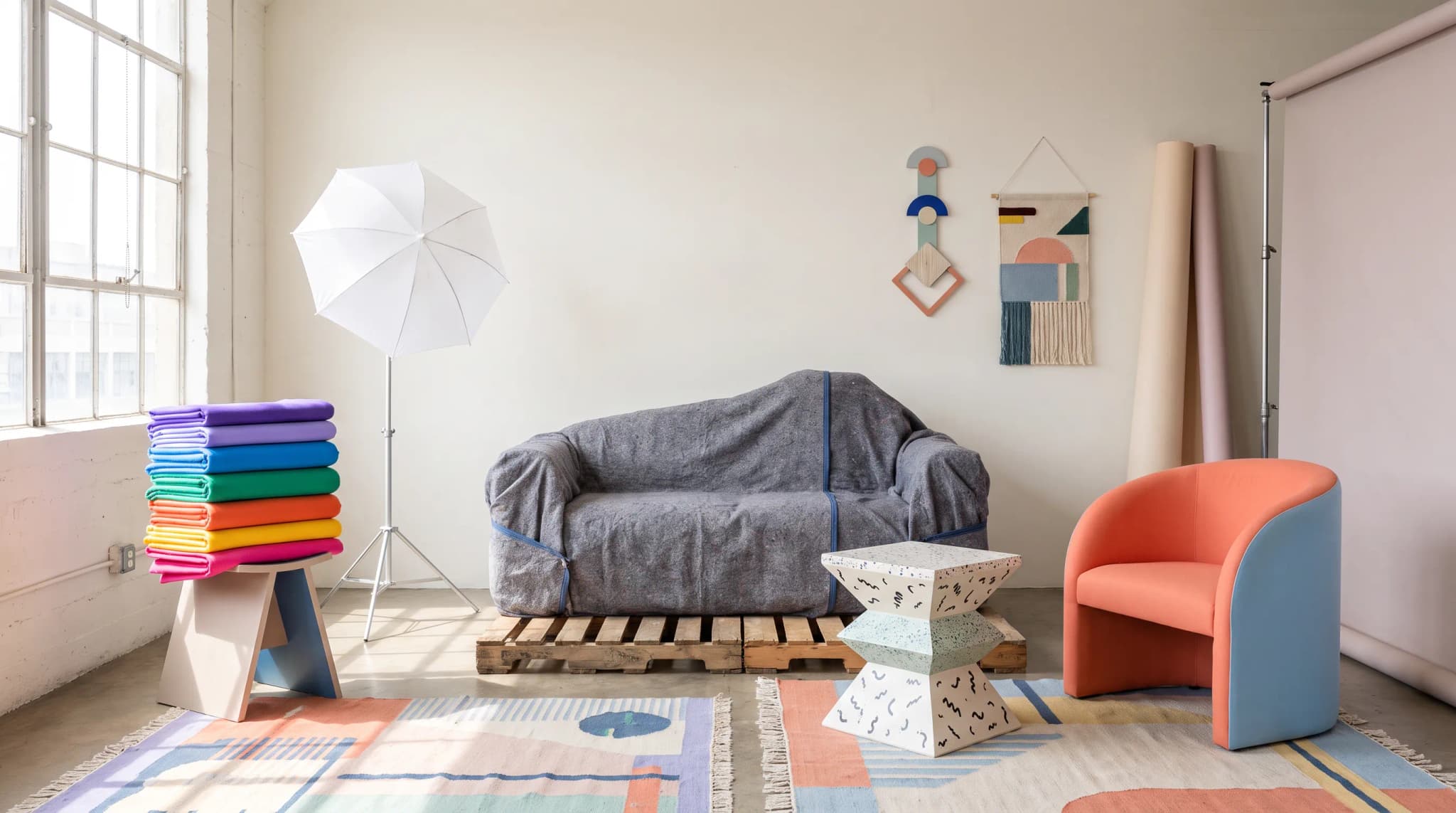
- Studio hire and lighting equipment
- Photographer and assistant time
- Set building, props and styling
- Product preparation and assembly
- Retouching and color correction
- Additional angles and detail shots
- Usage rights and licensing
- Revisions or reshoots
A sofa that needs three people to position, a room set and fabric-accurate retouching isn't the same job as a side table photographed against white.
What does AI furniture photography cost?
AI furniture photography uses an existing product image to create additional assets. Those assets can include room scenes, clean-background images, fabric or finish variations, crops and short videos. Our guide to how AI furniture photography works covers the workflow behind each of those outputs.
The starting image still matters. If the product has never been photographed, the cost of creating an accurate reference image remains part of the budget.
Furniture Connect runs on monthly credit plans, and a quality image uses 10 credits. The Starter plan gives one person 100 credits a month. The Growth plan gives a team of up to three people 1,000 credits a month to share. Enterprise packages are tailored to the team and the volume, and every plan can be billed monthly or yearly. You can move to a larger plan in the app whenever the team needs more capacity.
Every plan includes catalog and digital asset management capabilities, with a catalog of up to 50 products on Starter and 100 on Growth. Enterprise packages are tailored to the catalog and lift that limit. [4]
Credit use depends on the operation, and a generated image may still need correction or regeneration before it's approved. A plan's credits should therefore be treated as production capacity, not a guaranteed count of finished images.
An illustrative cost-per-SKU example
The table below is an example, not a customer quote or an industry benchmark.
Assume each SKU needs four generated outputs during the month. That could be a mix of packshots, lifestyle scenes and colorway assets. The calculation converts those outputs into Furniture Connect credits at 10 credits per quality image.
| Catalog worked on that month | Generated outputs required | Credits required |
|---|---|---|
| 20 SKUs | 80 images | 800 |
| 50 SKUs | 200 images | 2,000 |
| 100 SKUs | 400 images | 4,000 |
| 125 SKUs | 500 images | 5,000 |
That's 40 credits per SKU at any catalog size. This calculation counts credits only and assumes each output is approved the first time. It doesn't include reference photography, employee review time or regenerations.
The table shows the commercial difference between the two production models. Traditional photography prices each physical shoot, setup or finished image. A subscription gives the team a pool of production capacity that can be spread across more products. For CGI alongside both, see furniture imagery cost per SKU.
For the production choices behind these numbers, compare furniture photography studios vs AI across a complete SKU image set.
How each route is priced
Each production route charges for different things, which is why headline prices rarely line up.
| Route | How it's usually priced | What drives the final cost |
|---|---|---|
| Studio photography | Day rate, hourly rate or per image | Transport, set building, styling, retouching and a separate shoot for each physical colorway |
| CGI rendering | Per 3D model, then per render or angle | Modeling every product before the first image exists, then each extra scene or angle |
| General AI image tools | Monthly subscription | Prompting, checking and correcting each image by hand, then filing it against the right product |
| Furniture Connect | Plan with monthly credits | The first accurate reference image, review time, and how much of the plan's capacity is used |
A traditional packshot example
Here is a second illustrative calculation using one of the published photography prices above.
Suppose a range contains 20 products in four physical colorways. One white-background image is required for each product-colorway combination, creating 80 packshots.
At the published starting price of CA$27 per white-background image, the image line would be CA$2,160. The studio also publishes a CA$150 hourly charge and CA$50 setup fee, so the final invoice would depend on the hours required. [2]
That figure doesn't include lifestyle room scenes. It shouldn't be compared directly with the Furniture Connect subscription table, because the services, currencies and deliverables differ. Its purpose is to show how repeated physical colorways increase the image count before styling or room-set work begins.
Where AI changes the cost
The financial difference becomes clearer when a range needs more than one approved image per product.
Additional colorways
Traditional photography requires the physical product or cover in each colorway to be available and photographed. AI can create another colorway from an approved product image and material reference, then send it through product-fidelity review.
This is useful when the shape stays constant but the fabric, leather, paint or finish changes. Fine texture, grain and reflectivity still need close human review.
Lifestyle room scenes
A physical lifestyle shoot may require a large studio, furniture handling, props and a stylist. AI can place an approved product into several room settings without rebuilding a set for every scene. That's the lifestyle imagery workflow most catalogs run out of budget for.
That doesn't make every generated room image publishable. The product itself must still match the reference, and the scene must suit the brand and sales channel.
The catalog-scale lifestyle imagery workflow covers the briefs, reusable scenes and approvals that belong in that budget.
Catalog refreshes
Changing a background, crop or campaign treatment doesn't necessarily justify moving the product back into a studio. Once the accurate source image exists, the team can create new supporting assets from the same product record.
The value isn't simply a cheaper image. It's having more of the range ready for product pages, retailer requests, proposals and campaigns.
What AI doesn't remove from the budget
AI furniture photography still requires people and accurate source material.
Budget for:
- Creating or sourcing the first accurate product image
- Supplying approved fabric, finish and color references
- Reviewing silhouette, proportions, materials and construction details
- Correcting or regenerating inaccurate outputs
- Preparing the right crop and resolution for each channel
- Naming, storing and linking approved assets to the correct SKU
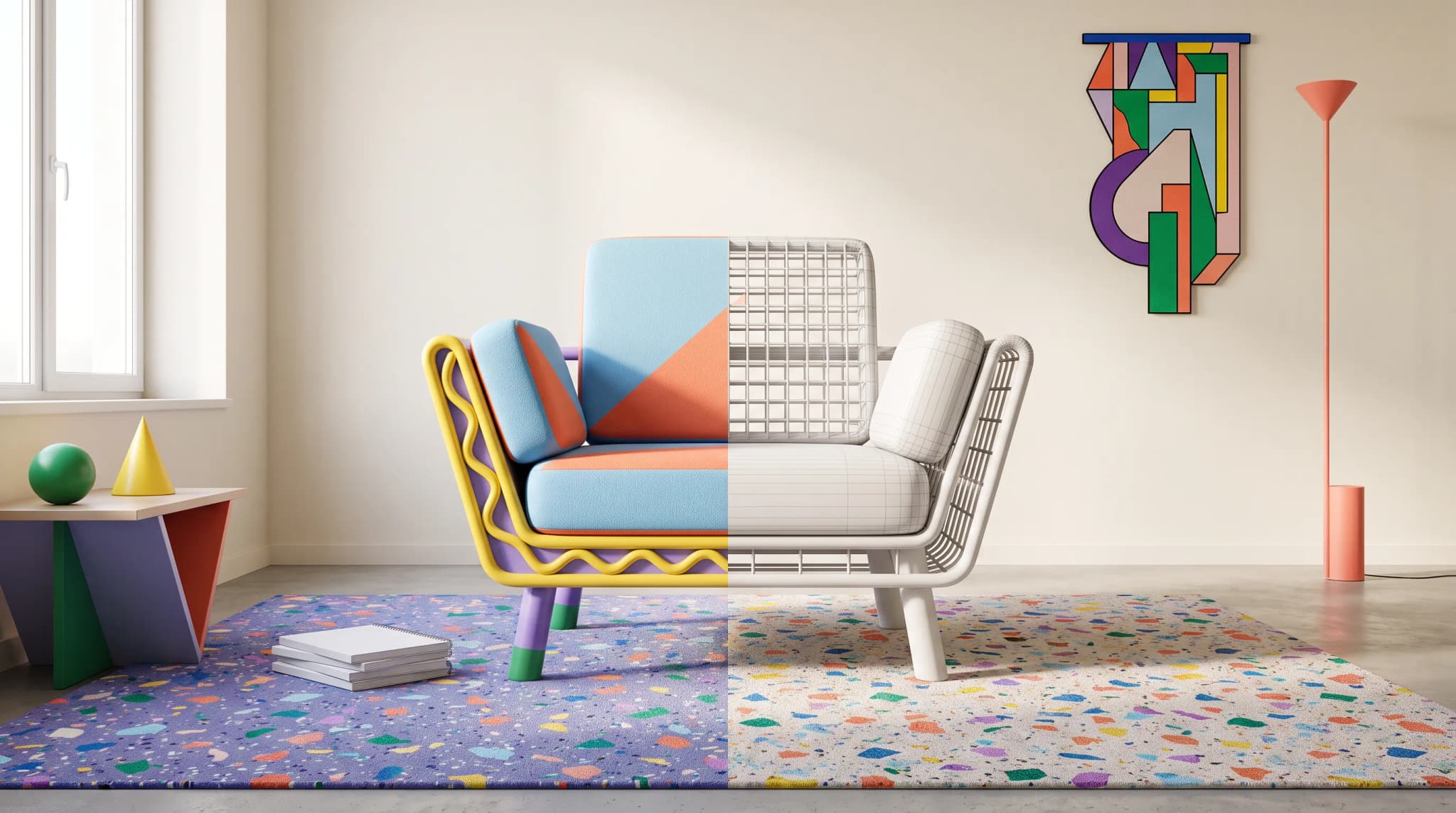
When the Furniture Connect Agent generates or edits product imagery, it automatically compares the result with the product reference. It checks whether the product is present and whether its silhouette, proportions, material, finish and color match.
The image then comes to the user for approval, changes or rejection. If an approved image belongs to a catalog variant without its own image, Furniture Connect asks before linking it to that named product and colorway. Nothing is attached silently.
This review time is a real cost. It's also what separates image generation from a usable catalog workflow.
When traditional photography is still worth the cost
Physical photography remains the stronger choice when the customer needs to inspect something the reference image can't establish reliably.
That may include:
- A distinctive weave, grain or reflective finish
- A recliner, sofa bed or other moving mechanism
- Construction details hidden in the available source image
- A new product with no accurate reference photography
Many furniture teams use a hybrid model: physical photography for the definitive product reference, then AI for additional scenes, colorways, campaign imagery and channel assets. If CGI is also on your shortlist, our CGI versus photography breakdown covers that third route.
How to compare quotes properly
Build one brief and ask every supplier or platform to price the same output.
Record:
- The number of products and colorways
- The number of packshots, lifestyle scenes and detail images per SKU
- Which physical products already have accurate reference images
- Transport, handling, set, styling and retouching requirements
- The number of review and revision rounds included
- Required crops, resolutions and sales channels
- Where approved assets will be stored and linked
Then divide the total by the number of approved SKUs or approved assets. Don't compare one studio day with one AI generation. Neither tells you what it costs to finish the job. The savings calculator runs that sum against your own numbers.
Frequently asked questions
How much does furniture product photography cost?
There is no universal rate. Published examples range from per-image pricing with size restrictions to hourly photography plus setup fees and separate studio hire. One large-product UK studio publishes £395 plus VAT for a full day, excluding the photographer. Check what the quote includes before calculating a cost per SKU.
Is AI furniture photography cheaper than a physical shoot?
It can have a much lower marginal cost when an accurate reference image already exists and the range needs several scenes or colorways. The honest comparison must also include reference photography, review time, corrections and channel preparation.
Does Furniture Connect charge per image?
No. Furniture Connect uses plans with a monthly pool of credits, and a quality image uses 10 credits. Plans run from a one-person Starter plan to a Growth plan for small teams, and larger catalogs move to a tailored Enterprise package.
Do I still need a photographer?
Only if the product doesn't yet have an accurate reference image, or a material detail needs to be captured closely. Once that image exists, AI covers the rest, from supporting scenes, crops and colorways to campaign hero shots, so the physical shoot doesn't need repeating.
Can Furniture Connect work from CAD files?
Furniture Connect doesn't create, read or import architectural CAD formats such as DWG, DXF, RVT or SketchUp files. It can work from a product photograph or a flat image or PDF exported from a CAD workflow. It can also generate a viewable 3D model from a clear product image.
What should be included in a cost-per-SKU calculation?
Include reference photography, production or subscription charges, product transport, styling, retouching, review time, rejected outputs, revisions and channel preparation. Use approved assets as the final measure, not raw images generated.
See what the workflow looks like on your range
Bentincks reduced product-upload time from two to three weeks to just over one week. [5] FW Style reported a 30% increase in sales conversion after adopting Furniture Connect imagery. [6] These are individual customer results, not promised outcomes, but they show what to measure beyond the image price: how much of the catalog is ready to sell and what happens once customers see it.
Bring one of your existing product images to a Furniture Connect demo. We'll create a new asset, show you the product-fidelity check and let you review the result before anything is linked to your catalog.
Sources
- Granary Digital: large-product production studio pricing
- Furniture photography hourly and per-image pricing (Canadian studio rate card)
- Full-service furniture photography pricing and size restrictions
- Furniture Connect: pricing
- Furniture Connect: Bentincks customer story
- Furniture Connect: FW Style customer story