Furniture Imagery Cost Per SKU: Studio vs CGI vs AI (2026)
What one furniture image and one fully covered SKU cost with studio photography, CGI and AI in 2026, using published rates, a worked 1,000-SKU example and the hidden costs each method leaves off the quote.
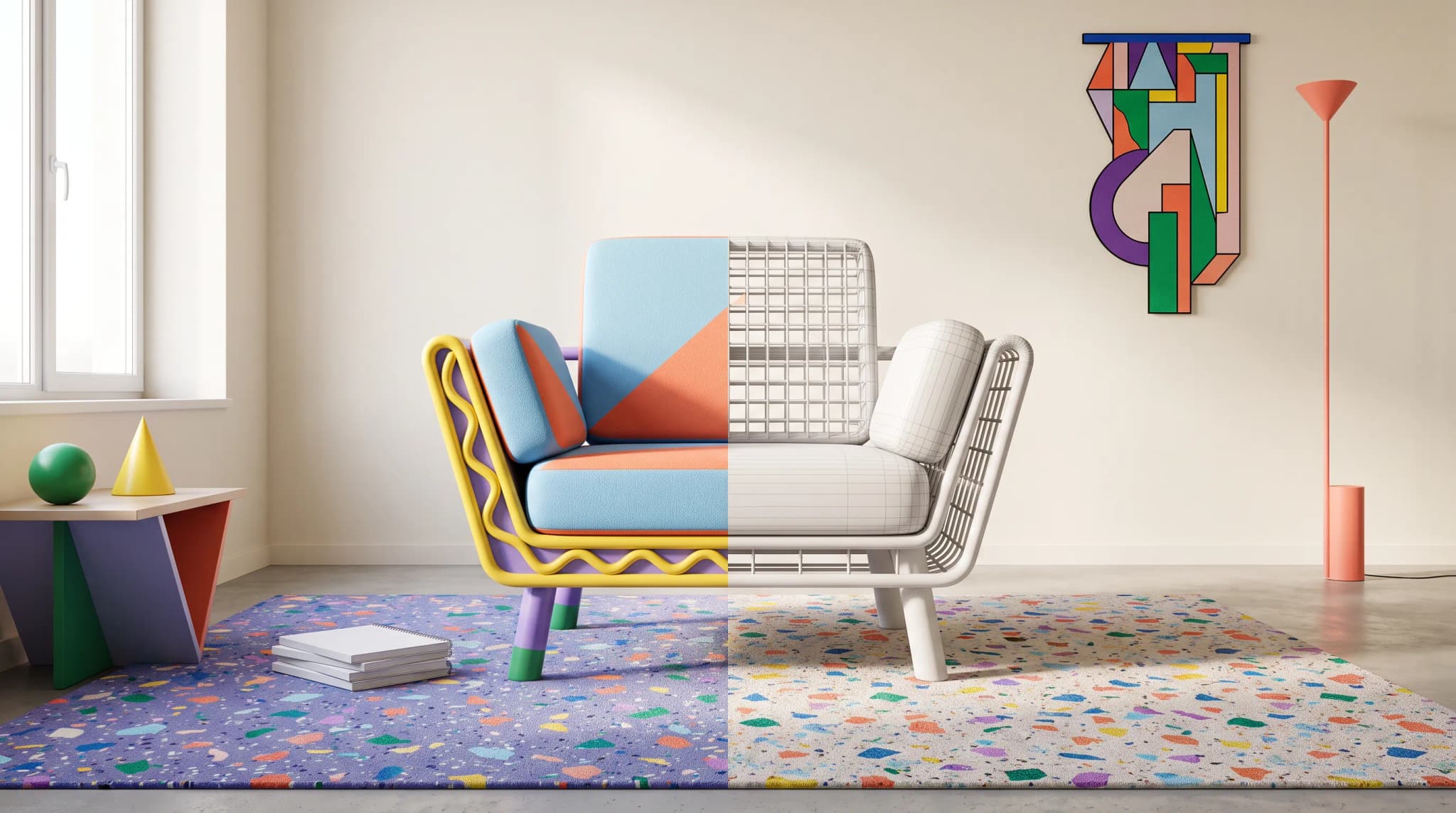
Imagery budgets are usually set per image, but furniture is sold per SKU. A sofa that ships in 10 fabrics is 10 SKUs, and a typical listing set for each one is a hero, an angle, a detail and a room scene.
That's why two quotes that look similar per image can be an order of magnitude apart per catalog. The useful number is cost per covered SKU: every image a sellable variant needs, on every channel that sells it.
This guide prices that number three ways, using only published rates, and shows the arithmetic so you can swap in your own.
How much does a furniture image cost with studio, CGI and AI?
A furniture image costs $50 to $300 from a studio, $5 to $470 from a CGI studio depending on the shot, and about $1 to $2.59 from an AI platform, on prices the studios and platforms publish on their own sites.
| Method | Image type | Published price per image | Source |
|---|---|---|---|
| Studio photography | Furniture and large items | $50 to $300 | ProShot Media, one Los Angeles studio |
| Studio photography | White background, entry-level studios (all categories) | $25 to $75 | Squareshot |
| Studio photography | Day rate | $1,500 to $5,000 per day | Squareshot |
| CGI | White-background silo | $5 to $7 (volume orders) to $25 to $80 | CGIFurniture, Furniture CGI |
| CGI | Lifestyle or room scene | $100 to $200 (volume) to $470 (one-off) | CGIFurniture, Furniture CGI |
| CGI | 3D model, needed before any render | $60 to $970 per model | CGIFurniture, Orbe3D |
| AI (Furniture Connect) | Quality image | About $1.00 to $1.30 | Published plans |
| AI (Furniture Connect) | Pro image (material swaps, demanding detail) | About $2.00 to $2.59 | Published plans |
Studio rates exclude samples, freight and set builds. CGI rates exclude the model unless stated. The AI figures exclude your team's review time, which is real work and shouldn't be skipped.
CGI vs AI-generated images for furniture catalogs: which is cheaper?
AI-generated images are cheaper than CGI for furniture catalogs on every published rate we found, and the gap grows with the variant count. CGI's economics are build-once: the 3D model is the expensive part, and further views get cheaper once it exists. CGIFurniture, for instance, quotes bulk color variants from the same setup from $0.20 per image. Lifestyle scenes are the exception, because each new room still carries a per-scene price of $100 or more.
That's where AI changes the per-SKU math most. A room scene generated from an approved product photo costs about $1.00 to $1.30, and the same piece can be restaged per season or market without a new invoice.
CGI keeps real advantages:
- CAD-exact silos where every dimension is contractual
- Pieces that don't exist yet, rendered from CAD before a sample is made
- 360 spins, AR and configurators, which need a 3D model anyway
- Animation and campaign work
Large brands moved product shots to CGI for exactly these reasons. IKEA said in 2014 that around 75% of its product images were computer-generated (CGSociety, archived). As Slate's correction later clarified, that figure covers single product shots; most of IKEA's catalog images were still photographed. The next shift is the same logic applied to variants and room scenes.
3D CGI rendering cost per SKU vs AI
Per SKU, CGI costs a model plus every view and scene; AI costs a set of generations from one approved image. Using one studio's published volume rates (CGIFurniture: medium model $120, silo $5 to $7, close-up $30, lifestyle scene $100 to $200), a four-image SKU looks like this:
| Line | CGI (volume rates) | AI with Furniture Connect |
|---|---|---|
| Source asset | 3D model, $120 | An approved product photo or render you already have |
| Two silo views | $10 to $14 | Usually your existing cutouts, cleaned up |
| One close-up | $30 | Photograph or render it; detail is where AI shouldn't stand in |
| One room scene | $100 to $200 | About $1.00 to $1.30 (Quality) |
| First SKU | $260 to $364 | About $1 to $1.30 plus your source shots |
| Each extra fabric of the same piece | Re-renders at variant pricing, plus a new scene | About $2.00 to $2.59 per image (Pro-mode material swap) |
The table is an illustration built from one published rate card, not a quote. The point it makes holds across vendors: AI depends on a good source image, so its cost per SKU is lowest when you already have one approved hero per base product.
What does it cost to cover 1,000 SKUs?
Here's a worked example, labeled clearly as illustrative. Take 100 sofas, each in 10 fabrics: 1,000 sellable SKUs. Each SKU needs four images: a white-background hero, one angle, one close-up and one room scene. That's 4,000 images.
| Approach | The arithmetic | Total |
|---|---|---|
| Photograph every variant | 4,000 images × $50 to $300 (one studio's furniture rate) | $200,000 to $1,200,000, plus samples, freight and sets |
| CGI for every variant (CGIFurniture volume rates) | 100 models × $120 = $12,000; 2,000 silos × $5 to $7 = $10,000 to $14,000; 1,000 close-ups × $30 = $30,000; 1,000 scenes × $100 to $200 = $100,000 to $200,000 | About $152,000 to $256,000 |
| Hybrid: CGI for the 100 base products, AI for the other 900 fabric SKUs | CGI base set: $12,000 + $1,000 to $1,400 + $3,000 + $10,000 to $20,000 = $26,000 to $36,400. AI: 3,600 Pro-mode fabric swaps × $2.00 to $2.59 = $7,200 to $9,324 | About $33,000 to $46,000 |
| AI from existing approved photos | Up to 4,000 images, mostly Pro-mode swaps, × $2.00 to $2.59 | Up to $8,000 to $10,360, plus review time |
Four caveats keep this honest:
- Bulk variant pricing from a CGI studio can bring its silo line down sharply, so ask for it.
- At this volume you'd be on an annual or Enterprise plan, and Enterprise pricing is quoted rather than published.
- Not every generation becomes a finished image. Even at three generations per approved image, the AI line stays a small fraction of the others.
- Detail shots of weave, grain and hardware deserve a camera or a render. The hybrid row renders the hero and detail shots of each base product in CGI; the close-ups for the other nine fabrics are AI swaps of that approved CGI close-up, so they need the closest review against the physical swatch.
Run the same math on your catalog, or read why furniture product photography is so expensive for where the studio costs come from.
How much does AI furniture product photography cost per image?
AI furniture product photography costs about $1.00 to $1.30 per image on Furniture Connect's published plans, or about $2.00 to $2.59 for Pro-mode images such as fabric and finish swaps. The figures come straight from plan prices and credit costs:
| Plan | Price | Credits | Quality image (10 credits) | Pro image (20 credits) |
|---|---|---|---|---|
| Studio Plus, monthly | $259 a month | 2,000 | About $1.30 | About $2.59 |
| Studio Pro, monthly | $599 a month | 5,000 | About $1.20 | About $2.40 |
| Studio Plus, yearly | $2,599 a year | 24,000 | About $1.08 | About $2.17 |
| Studio Pro, yearly | $5,999 a year | 60,000 | About $1.00 | About $2.00 |
Downloads are free, switching between 1K, 2K and 4K costs no extra credits, and every plan includes unlimited team members sharing one credit pool. Enterprise plans add the Agentic Catalog and DAM, with credits quoted to your volume.
General-purpose AI tools can look cheaper per generation. Rapid Renders, a CGI studio, puts them at roughly $0.50 to $5 per image on tools that cost $10 to $120 a month. The catch, which Rapid Renders also points out, is the staff time spent rejecting and fixing outputs that don't hold a product's shape or fabric. The number to compare is cost per approved image of your actual product, not cost per generation.
Cost of AI lifestyle scenes for a full catalog
Lifestyle scenes are the most expensive line in furniture imagery and the one AI reduces most. At published CGI rates of $100 to $200 per scene on volume orders, two room scenes for each of 1,000 SKUs cost $200,000 to $400,000. Generated with Furniture Connect in Quality mode, the same 2,000 scenes cost about $2,000 to $2,600, plus review.
The bigger difference is what happens next season. A CGI scene restyled for a new palette is a new scene; a generated one is a new prompt. Scatterbox reports setting new scenes in about 15 to 60 seconds instead of weeks of location planning, and Hartman reports gaining about a month on its brochure design cycle by generating lifestyle imagery instead of shooting it.
Keep the scenes honest. Each one should show the right piece, in the right fabric, at the right scale for the room, and a person should approve it against the product before it's published or linked to a variant.
What hidden costs do CGI and studio shoots have?
The quote is rarely the bill. These are the costs each method leaves off the per-image price:
| Hidden cost | Studio photography | CGI | AI |
|---|---|---|---|
| Samples | A production sample per colorway, often before stock exists | Not needed; CAD and swatches | One approved photo or render per base product |
| Freight and handling | Crating, pallets, two-person lifts, return shipping | None | None |
| Model preparation | None | $60 to nearly $1,000 per model; Maverick Frame cites $5,450 to repair a raw engineering file against $2,200 from a clean handover | None for stills; a 3D model only if you need AR |
| Sets, props and styling | Per scene | Scene building per environment | Described in the prompt |
| Revisions and variants | A reshoot | Re-renders; Maverick Frame puts extra colorways at 20 to 40% of the first image | A new generation |
| Rush delivery | Studio premium | 30 to 50% for under five business days (Maverick Frame) | Not applicable |
| A discontinued fabric | Reshoot every affected piece | Re-render every affected view | Regenerate from the updated record, then review |
| Review | Retouching QA | Checking renders against the spec sheet | Checking every image against the real product |
The last row matters. AI moves cost from production to review, and that review is what keeps the imagery accurate. Rapid Renders makes the same point about generic AI tools: someone has to generate, reject and fix the outputs, and you still need clean photos of every product to start from.
How to measure your own cost per image
Don't take any vendor's math, including ours. Measure it on one range.
- Capture a baseline first: cost per image, time to market from product-ready to a live listing with lifestyle imagery, image consistency across channels, and how many products are live without lifestyle imagery.
- Pick one range of 10 to 30 products that has waited longest for imagery.
- Run the pilot for two to four weeks, using the new workflow as the primary imaging route for those products.
- Compare side by side, including the review hours.
Our guide to piloting on one range sets out the full method. The savings matter most once a catalog passes roughly 200 SKUs or sells through more than two channels; below that, one good shoot a year may still be the cheapest answer.
For a decision by product type rather than by price, see CGI vs photography for furniture and our furniture CGI vs photography overview. If you're choosing a CGI supplier, our guide to the best furniture CGI studios compares published rates and turnaround.
Frequently asked questions
Is AI cheaper than CGI for furniture?
Yes, per image and per SKU. Published CGI rates run from $5 to $7 per silo render on volume orders up to $100 to $470 per lifestyle scene, plus $60 or more per 3D model, while AI imagery on Furniture Connect's published plans costs about $1.00 to $1.30 per image, or $2.00 to $2.59 for Pro-mode fabric swaps. CGI is still the better buy for CAD-exact silos, animation and pieces with no photo yet, which is why most catalogs use both.
What does one AI furniture image cost?
On Furniture Connect's published plans a Quality image uses 10 credits, which works out at about $1.00 to $1.30 depending on the plan. A Pro-mode image, used for material swaps and demanding detail, uses 20 credits, about $2.00 to $2.59. Downloads are free and switching between 1K, 2K and 4K costs no extra credits. Budget for a few more generations than finished images, because every image is reviewed before it's published.
What does it cost to cover 1,000 SKUs?
In our worked example (100 sofas in 10 fabrics, four images per SKU), photographing every variant at the $50 to $300 per photo one Los Angeles studio lists for furniture comes to an illustrative $200,000 to $1.2 million before samples and freight. CGI for every variant at one studio's volume rates comes to about $152,000 to $256,000. A hybrid, with CGI for the 100 base products and AI for the 900 other fabric variants, comes to about $33,000 to $46,000. Your numbers will differ, so run them with your own rates.
What hidden costs do CGI and studio shoots have?
Studio shoots add production samples, freight and two-person handling, studio space, sets, stylists, retouching and a reshoot whenever a fabric changes. CGI adds 3D model preparation (published at $60 to nearly $1,000 per model, more if CAD files need repair), revision rounds, rush fees of 30 to 50% for fast turnaround, and re-rendering when the range changes. AI has a hidden cost too: review time, because every generated image needs checking against the real product.
To price your own range, book a Studio demo and bring a supplier spreadsheet and a few product shots.
Sources
- ProShot Media: Product Photography Pricing in 2026 (August 28, 2025), a Los Angeles product photography studio's own price of $50 to $300 per photo for furniture and large items.
- Squareshot: product photography per-image pricing, entry-level $25 to $75 per image and day rates of $1,500 to $5,000.
- CGIFurniture: silo rendering, lifestyle rendering and 3D modeling price lists.
- CGIFurniture: 3D rendering price factors, $30 per close-up or custom view.
- Furniture CGI: services, silo and lifestyle price ranges.
- Orbe3D: price page, $70 to $380 per 3D model.
- Rapid Renders: AI vs CGI for product images, per-image cost of generic AI tools and the hidden costs of AI-only workflows.
- Maverick Frame: 3D rendering pricing, extra colorway pricing and rush premiums.
- Maverick Frame: 3D furniture modeling services, repair cost of raw engineering files.
- CGSociety: Building 3D with IKEA (archived) and Slate's correction, the share of IKEA product images that are CG.