Best Furniture CGI Studios for Catalogs and Ecommerce (2026)
The furniture CGI studios worth shortlisting in 2026 (CGIFurniture, Danthree, Furniture CGI, Orbe3D and more) with their published prices and turnaround, how to judge 3D renders for catalogs and ecommerce listings, and when AI imagery is the better buy.
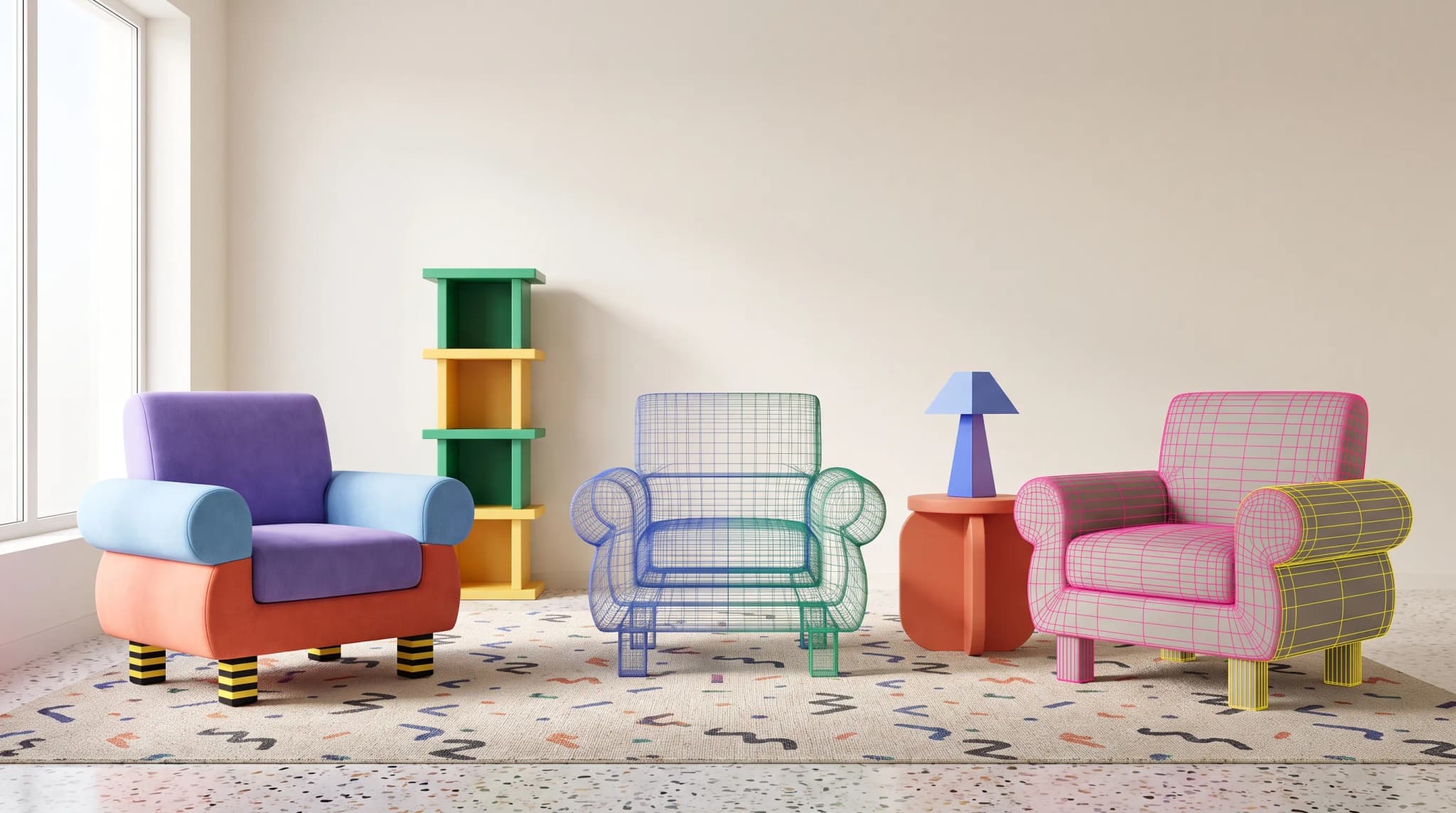
Commissioning furniture CGI usually starts the same way. A new range needs imagery before the containers land, someone gathers CAD files and fabric swatches, and a render studio quotes per image. The first hero shots come back beautiful.
Then the range turns out to have 14 fabrics, the buyer asks for three room scenes per piece, and Amazon, Wayfair and your own storefront each want their own crops. The math, and the timeline, stops working.
So "who's the best furniture CGI studio?" is really two questions: which studios do the best work, and whether a studio is the right kind of supplier for the job at all. This guide answers both, with every price and turnaround taken from the studios' own published pages.
How we ranked these furniture CGI studios
No ranking survives contact with your own products, so here's how this one was built. We weighted five things a furniture catalog team actually pays for:
- Furniture focus. How much of the studio's published work and positioning is furniture, rather than architecture or general product CGI.
- Catalog capacity and consistency. Evidence the studio can produce hundreds of images that match each other, not 20 that look good alone.
- Price transparency. Whether rates are published, so you can budget before a sales call.
- Published turnaround. How fast standard work comes back.
- Variant economics. What a second fabric or finish costs once the first image exists.
We didn't run paid pilots with each studio. Treat the order as a shortlist to test, not a verdict.
The best furniture CGI studios in 2026, compared
| Rank | Studio | Based in | Best for | Published price | Published turnaround |
|---|---|---|---|---|---|
| 1 | CGIFurniture | London, UK | Catalog volume, variants, 360 spins and AR on commissioned terms | Silo $5 to $7; lifestyle $100 to $200 on volume orders, $200 to $470 one-off; 3D model from $60 | 2 to 3 business days for product packages; up to 48 hours per lifestyle render |
| 2 | Danthree Studio | Salach, Germany | Art-directed hero imagery and campaigns for premium brands | Not published, quote-based; its blog puts premium projects at $10,000 to $50,000 and above | Days for simple renders, weeks or months for complex projects |
| 3 | Furniture CGI | New York, US | Marketplace listing sets for US ecommerce brands | Silo $25 to $80; lifestyle $150 to $400; full Amazon image stack $400 to $800 per product | 1 to 5 business days; silos in 48 hours |
| 4 | Orbe3D | Atlanta, US (production in Dhaka) | 3D models, 360 spins and AR files at volume | $70 to $380 per model by complexity and volume | 24 to 48 hours for standard pieces |
| AI alternative | Furniture Connect | Software platform | Variants, lifestyle scenes and catalog volume generated from the product record | About $1.00 to $1.30 per image on published plans | Seconds to minutes per image, plus review |
Two notes on the table. Orbe3D's own pages disagree on its starting price: its price page starts at $70 per model, while its list article says "around ~$39". And Furniture CGI's site links to the same Trustpilot profile as CGIFurniture and shows largely the same client logos; it doesn't say how the two are related, so check who you're contracting with.
1. CGIFurniture
CGIFurniture is the most transparent of the furniture specialists. It publishes a price list across silos, lifestyle scenes, 360 spins, 3D models and AR models, and says it has worked with product brands since 2011.
Its variant pricing is the detail catalog teams should notice: for bulk requests such as every color of a product rendered from the same setup, it quotes from $0.20 per image once the model exists. That's commissioned CGI working the way catalogs need it to.
2. Danthree Studio
Danthree is a high-end studio whose team includes master carpenters, and its client list leans to premium European furniture brands. It doesn't publish fixed prices; its project planner produces a brief, not a quote.
Choose it when the image is a brand investment: a flagship launch, a campaign, a product film. Don't choose it to fill 400 listing slots.
3. Furniture CGI
Furniture CGI positions itself for US ecommerce brands and publishes listing-shaped pricing, including a full Amazon image stack (silo, three lifestyle scenes and a detail) at $400 to $800 per product. It quotes 1 to 5 business days and includes unlimited revisions.
4. Orbe3D
Orbe3D is a volume 3D modeling and rendering producer that also works white-label for agencies. Its price page tiers models at $70 to $380 depending on complexity and order volume, with glTF and USDZ files for AR included from its middle tier. If what you need is a 3D model per SKU for AR or a configurator, rather than finished catalog stills, it belongs on the shortlist.
Also worth testing
- Pikcells (Huddersfield, UK, with a US presence): CGI room sets and high-volume silos, 360s and AR, strongest in kitchens, bathrooms and furniture. No published prices or turnaround.
- Maverick Frame (London): a general CGI studio rather than a furniture specialist, with fixed project quotes or hourly work from $30 an hour. It quotes 3 to 5 working days for a first still and 2 to 3 weeks for a set of five to eight views.
- 7CGI, OmegaRender and Render Furniture appear on Orbe3D's own ranking lists. We couldn't verify their pricing, so test them the same way.
Managed services such as Rendify build 3D models and renders from CAD and reference files; our Rendify comparison shows how that differs from generating catalog imagery.
What's the best furniture CGI company for product renders?
The best furniture CGI company for product renders depends on which render you mean, because the three common types reward different studios:
- White-background silos are commodity work at volume. Published rates run from $5 to $7 (CGIFurniture, volume orders) to $25 to $80 (Furniture CGI). Choose on consistency and file delivery, not artistry.
- Hero renders for a launch or campaign are craft. Danthree and Pikcells show the strongest art direction in their published work, and both quote per project.
- Lifestyle and room scenes are where cost climbs fastest ($100 to $470 per scene at CGIFurniture, $150 to $400 at Furniture CGI) and where generative AI now competes hardest, for reasons covered below.
A practical shortlist for most furniture brands: one specialist for silos and 3D models, one for hero work, and a platform for the variants and scenes in between.
Which furniture CGI studio has the best 3D renders for catalogs?
For catalogs, the best 3D renders are the most consistent ones, not the most beautiful single image. On a product page an image stands alone. In a print catalog, a showroom screen or a category grid it sits inches from 40 of its siblings, under what should be the same light. One render with a warmer floor or a camera 10 centimeters lower, and the spread looks assembled from three suppliers.
One great render is craft; 400 consistent ones are logistics. Judge catalog studios on three things:
- Consistency systems, not talent claims. Ask how camera height, lens, lighting and floor treatment stay identical across a product family rendered weeks apart. Scene templates and locked rigs are good answers. "Our artists are experienced" is not.
- Revision economics. Catalogs change constantly: a discontinued fabric, a corrected dimension, a new season's palette. Ask for the update price before the pilot price. Maverick Frame, for example, says extra colorways of an already-modeled SKU cost 20 to 40% of the first image, because the master scene is reused.
- Delivery into your systems. A folder of PNGs isn't delivery. Files should arrive named, sized per channel and attached to the right SKU in your product data, or your team pays the integration cost the studio saved.
Ask every studio for 50 consecutive images from one client's catalog. The portfolio shows its best 20; the consecutive 50 show what your grid will look like.
Who provides the best furniture CGI rendering for ecommerce listings?
For ecommerce listings, the best provider depends on volume, because listings have the least forgiving economics in furniture imagery. A listing typically needs a hero, alternate angles, a detail, a dimensions view and at least one room scene, and each marketplace sets its own image rules.
At Furniture CGI's published $400 to $800 per product for a full Amazon image stack, 200 products cost $80,000 to $160,000 before a single fabric variant. That's an illustration from one published rate card, not a quote, but it shows why the answer splits:
- Under about 20 stable SKUs: a commissioned studio that packages listing sets, such as Furniture CGI or CGIFurniture, is a reasonable buy.
- Growing, variant-heavy catalogs with frequent launches: generating listing imagery from the catalog wins on cost and speed. Furniture Connect produces fabric and finish variants from an approved hero image, and keeps each image linked to its product. Bentincks, a UK sofa manufacturer, reports cutting retailer uploads from two to three weeks per range to just over one week.
- Made-to-order and pre-production pieces: CGI from CAD wins outright, because there's nothing to photograph yet.
Whatever the provider, hold listing imagery to the conversion standard: proportions that match the spec sheet, materials that read true and consistency across the grid. Check each retailer's own image requirements rather than assuming one export fits every channel.
Why CGI room scenes look plastic, and where generative AI now wins
Every team that commissions CGI room scenes has had the same review meeting. The renders come back technically flawless, and someone says the sofa looks like it's made of plastic.
The plastic look comes from perfection:
- Materials without history. Real wood grain never repeats; tiled textures do. Real fabric creases under its own weight; modeled fabric holds an idealized shape.
- Light without character. A photographer's light spills, bounces off a wall and warms a corner. Rendered light does exactly what it's told.
- Cleanliness no room has. No dust, no slightly crooked cushion. Shoppers read that sterility as fake even when they can't name why.
Generative image models learn mostly from photographs, so the qualities hardest to fake in CGI (light behavior, material texture, lived-in rooms) come more naturally to them. That's why furniture-tuned generation now often beats fully modeled CGI interiors on believability for lifestyle scenes, and can restage the same piece per season or market without rebuilding a 3D set. It's the model behind Furniture Connect's lifestyle imagery.
There's a limit. Some furniture categories are represented online mostly by renders, so general models reproduce a CGI look for them; our guide to the uncanny valley in furniture renders explains that training data gap and the tells to check for.
Photorealistic isn't the same as accurate
A render can look completely real and still be wrong: a seat two centimeters deeper than the spec sheet, a walnut finish two shades warm, piping that vanished between brief and delivery. On a listing, that image converts, and the returns desk inherits the difference.
Accuracy is a data problem. Renders drift when each one starts from a fresh brief: a PDF from one supplier, a spreadsheet from another, missing dimensions filled in by an artist's judgment.
Furniture Connect starts from the product record instead. Supplier files are imported into the Agentic Catalog, the catalog shows what's missing for each channel, and imagery is generated from the record's dimensions, materials and finishes. Each image then carries a review status, and a person approves it against the real product. Linking an image to an exact variant also needs a person to confirm it. Our piece on why AI images drift at catalog scale covers the data fix in detail.
When is AI a better choice than CGI for furniture?
AI is the better choice when the work is repetitive, variant-driven and deadline-bound; CGI is the better choice when the asset is singular, CAD-exact or animated.
| Imagery job | Better fit | Why |
|---|---|---|
| CAD-exact silo of a hero product | CGI or photography | Every dimension and stitch line is contractual |
| Detail and close-up shots | Photography or CGI | Weave, grain and hardware at full zoom |
| Fabric and finish variants | AI | One approved image, many covers, no new invoice per colorway |
| Lifestyle and room scenes | AI | Believable light, restaged per season or market |
| Pre-production pieces with no sample | CGI | Built from CAD; AI needs a photo or drawing to start from |
| 360 spins, AR and configurators | CGI (3D model) | Needs a 3D asset; see our 3D modeling guide |
| Animation and brand film | CGI studio | Craft and art direction |
The split matters most once a catalog passes roughly 200 SKUs or sells through more than two channels. Below that, a good studio and a careful team can hold a range together by hand. For the cost side, see our cost per SKU comparison of studio, CGI and AI.
When a commissioned CGI studio is still the right call
AI platforms haven't made specialist studios obsolete. Commissioned CGI still earns its fee on animation and brand film, complex scenes built around a campaign concept, CAD-exact visualization where every stitch line is contractual, and pieces that don't exist yet. If the asset is singular and the budget matches its importance, a studio like Danthree or Pikcells is buying craft, and that's a fair trade.
The mistake is paying craft prices for infrastructure. Most furniture imagery exists to fill listings, showroom screens and retailer briefs: repetitive, variant-driven and on a deadline. That work shouldn't sit in a render queue.
Seven questions to ask any furniture CGI provider
- Render one of our products in a difficult material (bouclé, high-gloss lacquer, cane) as a paid pilot. What does it cost and how long does it take?
- Now render the same piece in a second colorway. What did the variant cost?
- Show 50 consecutive images from one client's catalog, not the portfolio.
- A fabric is discontinued mid-season. What does updating every affected image cost, and how long does it take?
- How do finished files arrive: named, sized per channel and attached to the right SKU? Who does that work?
- What are the renders checked against, and who signs off that they match the spec sheet?
- What happens at 10 times this volume?
The pattern in the answers tells you whether you're hiring a studio for craft or trying to buy infrastructure from a supplier priced per image. Our evaluation framework for virtual furniture studios adds the remaining criteria, and CGI vs photography for furniture helps decide which images to commission at all.
Frequently asked questions
Which furniture CGI studio is best for catalogs?
For commissioned catalog work, CGIFurniture is the strongest all-round pick: it is furniture-focused, publishes volume pricing and quotes 2 to 3 business days for its product packages. Pikcells is worth testing for room sets across whole collections. Judge any studio on its consistency systems (scene templates, locked cameras), the cost of updating images when a fabric changes, and 50 consecutive images from one client. For variant-heavy catalogs, Furniture Connect generates imagery from the product record, which helps keep camera, light and fabric consistent across every SKU, and each image is reviewed before approval.
How much does furniture CGI cost per product?
Published 2026 rates vary widely. CGIFurniture lists white-background silos at $5 to $7 and lifestyle scenes at $100 to $200 on volume orders ($200 to $470 one-off), with 3D models from $60. Furniture CGI quotes $25 to $80 per silo, $150 to $400 per lifestyle scene and $400 to $800 for a full Amazon image stack per product. Orbe3D prices models at $70 to $380 by complexity and volume. Danthree and Pikcells quote per project. AI imagery on Furniture Connect's published plans works out at about $1.00 to $1.30 per image.
How long do CGI renders take?
Standard furniture CGI usually takes one to five business days. Furniture CGI quotes 1 to 5 business days with silos in 48 hours, CGIFurniture 2 to 3 business days for its packages, and Orbe3D 24 to 48 hours for standard pieces. Larger or art-directed work takes longer: Maverick Frame quotes 2 to 3 weeks for a set of five to eight views, and Danthree says complex projects can run to weeks or months. AI imagery from an approved product photo takes seconds to minutes per image, plus review time.
When is AI a better choice than CGI?
AI is the better choice for fabric and finish variants, lifestyle and room scenes, seasonal restyling and catalog volume, especially once a range passes roughly 200 SKUs or sells through more than two channels. CGI stays the better choice for CAD-exact silos, pieces with no sample or photo yet, animation and 360 spins built from a 3D model, and art-directed hero campaigns. Whichever you use, check every image against the spec sheet before it's published.
If your imagery bill is really a catalog problem, see how the Furniture Connect studio works from the product record, or run your own numbers against your last render project.
Sources
- CGIFurniture: silo rendering services, $5 Full HD and $7 4K per silo on volume orders, bulk color variants from $0.20 per image.
- CGIFurniture: lifestyle rendering services, $100 to $200 per scene on volume orders, $200 to $470 one-off.
- CGIFurniture: 3D modeling services, models from $60 at volume, $130 to $970 one-off.
- CGIFurniture: home page, product packages delivered in 2 to 3 business days.
- Danthree Studio: CGI project planner, no fixed prices, quotes per project.
- Danthree Studio: top 3D product visualization studios for US furniture brands, premium projects at $10,000 to $50,000 and above.
- Furniture CGI: services, silo and lifestyle price ranges and 1 to 5 business day turnaround.
- Furniture CGI: silo vs lifestyle furniture renders, Amazon image stack at $400 to $800 per product.
- Orbe3D: price page, $70 to $380 per model by tier and volume.
- Orbe3D: 10 best 3D furniture modeling companies in the USA, the "~$39" starting figure that conflicts with its price page.
- Pikcells, room sets and high-volume content; no published prices.
- Maverick Frame: 3D rendering pricing, hourly rate and the 20 to 40% cost of extra colorways.
- Maverick Frame: 3D furniture rendering services, turnaround for stills and sets.