Why Furniture Product Photography Is So Expensive, and 6 Ways to Cut the Cost
Furniture product photography costs more than most categories because of samples, freight, studio space, styling, retouching and a reshoot for every variant. Here's where the money goes, and six ways to reduce it without losing quality.
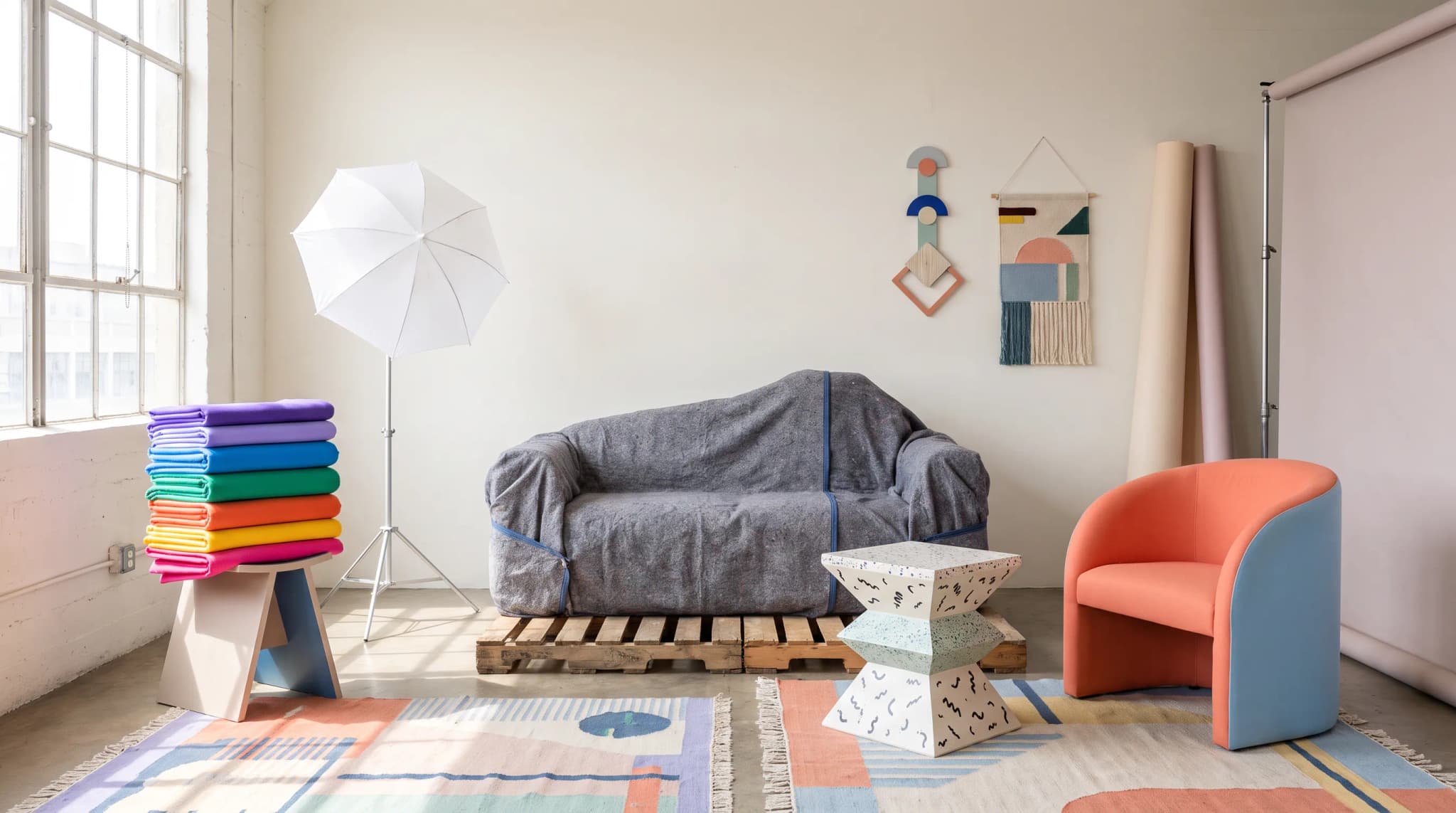
A three-seat sofa arrives at the studio crated, on a pallet, two weeks after the shoot was booked. It's in one fabric. The range ships in 14.
The photographer's day rate is the line on the invoice everyone looks at. It's rarely the line that hurts. The real bill is the freight, the samples, the set, the retouching and, above all, the second, third and fourteenth time the same sofa has to be shot because the buyer wants it in sage bouclé.
That's why furniture teams that negotiate hard on day rates often see their photography spend barely move.
Why is professional furniture product photography so expensive for retailers?
Professional furniture product photography is expensive because furniture is big, heavy and sold in more versions than almost any other category, so every cost a studio has scales with size and with the variant count. A phone case fits on a tabletop. A corner sofa needs a studio, a crew and a truck.
Here is where the money goes:
| Cost driver | Why furniture makes it worse | What it adds to the bill |
|---|---|---|
| Samples | A production sample per colorway, often before stock exists | Sample cost, or a shoot that waits for the container |
| Freight and handling | Crating, pallets, two-person lifts, damage risk, return shipping | Freight both ways, handling time, insurance |
| Studio space and sets | A large cyclorama for cutouts; built room sets for lifestyle | Studio rental and set build per scene |
| Stylists and props | Rugs, lamps, accessories and a stylist to dress each room | Stylist day rate and prop hire |
| Shoot time | Large pieces take longer to light, and each angle is a new setup | Day rates of $1,500 to $5,000 (Squareshot) |
| Retouching | Cutting out legs, fringing and cane; removing creases; correcting fabric color | $5 to $15 per photo as a standalone service (ProShot Media) |
| Per-variant shots | Every fabric, finish, leg and size is a separate photograph | Multiplies every line above |
| Reshoots on change | A finish is discontinued, a supplier changes the weave, a retailer asks for a new angle | The whole process again |
The variant multiplier
The last two rows are the ones that break budgets. A retailer buying 20 sofas, each in 10 fabrics, is selling 200 sellable variants. If each variant needs five listing images, that's 1,000 photographs.
At the $50 to $300 per photo one studio lists for furniture and large items, that's $50,000 to $300,000 before a single sample has been shipped or a room set built. The arithmetic is illustrative, but it explains why most catalogs photograph the bestsellers and leave the rest of the range on a single supplier cutout.
Why retailers feel it most
Retailers rarely control the source imagery. A supplier sends one white-background photo of a product it sells in several fabrics, finishes and sizes, which is exactly what Barker and Stonehouse describes receiving for new ranges.
The retailer then has two expensive options: commission its own shoot of someone else's product, or publish listings with gaps. Either way, the cost lands on the team with the least control over it.
How can furniture brands cut the cost of product photography without losing quality?
Furniture brands cut photography cost without losing quality by photographing less and getting more from every approved shot. The six fixes below are in the order most teams can apply them, and the last one is how you prove the savings before committing.
1. Shoot one hero per product, not one per variant
Keep photography or CGI for what it does best: the hero image and the detail shots that show stitching, grain, weave and hardware. Those are the images a shopper zooms into, and they deserve a real camera or an exact render.
Then produce the fabric and finish variants from that approved hero. A fabric swap takes a swatch, or a material or finish from your library, and renders the same piece in the new cover, so 14 colorways don't need 14 shoots. Check each swap against the physical swatch before it goes live; generated imagery needs human review, and fabric color is where it matters most.
2. Generate lifestyle scenes instead of building sets
Room sets are the most expensive photographs in furniture: a location or built set, a stylist, props, and a day per scene. Studio places an approved product image into a photorealistic room in a described or preset style, in seconds rather than weeks.
Scatterbox used this when a booked location didn't suit one collection, setting a new scene around it in about 15 to 60 seconds instead of restarting the location search, and the images went straight into its print catalog. Furniturebox builds whole-room scenes for pre-sales before stock arrives.
3. Fix existing photos instead of reshooting
Plenty of reshoots are booked to fix something small: a leg cropped at the frame edge, a backdrop that ran out in one corner, a power cable on the floor, a swing tag left on the arm.
Edit with Brush repairs those in place. Paint over the area, and it removes the distraction or extends the image to fix the crop, matching the scene's lighting. Background removal gives older cutouts a clean, consistent backdrop, and upscaling takes a low-resolution supplier shot to 4K for print.
Reshoot when the product itself has changed, or when the angle you need simply doesn't exist.
4. Standardize supplier photos rather than commissioning new ones
Mixed supplier photography is a cost problem disguised as a brand problem: the grid looks inconsistent, so the team pays for a new shoot. Cleaning up what already exists is usually far cheaper.
Customers report the scale of the difference. Barker and Stonehouse set a consistent gray background across its product imagery and moved from weeks of photography and editing to about 30 seconds per image. GJ Styles reports about 90% less time creating silhouetted images and preparing new product images. Gabriella White cut the time from shutter-click to website for silhouettes by about 40%. These are customer-reported results, not guarantees.
5. Batch by range and keep imagery attached to the product record
Paying for an image twice is common: once to create it, and again when nobody can find the version that shows the walnut leg. Generate and review by range in batches, and keep every approved image attached to the product and variant it shows. On Enterprise plans, Furniture Connect's Agentic Catalog and DAM hold that link for you.
Batch tools for edits, background removal and upscaling take up to 100 images per batch, so a range can be processed in a few runs rather than one image at a time. Linking an image to an exact variant still needs a person to confirm it, because the nearest-looking photo of a chair is not the same as the photo of the configuration being sold.
6. Pilot on one range for two to four weeks
Don't change the whole process on a promise. Pick one range of 10 to 30 products that has waited longest for imagery, and run the pilot set out in our guide to piloting on one range.
Before you start, capture the baseline: time to market, cost per image, image consistency across channels, team satisfaction, conversion rate, and the number of products live without lifestyle imagery. Run the new workflow as the primary imaging route for those products for two to four weeks, then compare the same numbers side by side. The result is your own evidence, not a vendor's.
What does furniture product photography cost per image compared with AI?
Studio photography for furniture costs tens to hundreds of dollars per finished image, while AI imagery generated from an approved product photo costs about a dollar. The comparison below uses rates studios and Furniture Connect publish on their own sites.
| Approach | Typical cost per image | Source |
|---|---|---|
| Studio, white background (entry level) | $25 to $75 | Squareshot |
| Studio, furniture and large items | $50 to $300 | ProShot Media, one Los Angeles studio |
| Furniture Connect, Quality mode | About $1.00 to $1.30 | Published Studio Plus and Studio Pro plans |
| Furniture Connect, Pro mode (material swaps, demanding detail) | About $2.00 to $2.59 | Same plans; Pro mode uses twice the credits |
Two caveats keep this honest. Studio rates exclude samples, freight and set builds, so the true studio figure is higher. The AI figure excludes your team's review time, which is real work and shouldn't be skipped. For the full method, including CGI, read the cost per SKU comparison of studio, CGI and AI, or run your own numbers.
Are cheaper furniture product photos good enough for retailers?
Cheaper furniture product photos are good enough when they're accurate, consistent and built to each channel's specification. Cost doesn't decide quality; the checks do.
Three checks matter before anything is published:
- Accuracy. Proportions match the spec sheet, the fabric reads true against the swatch, and the image shows the variant being sold.
- Consistency. Camera height, light and floor treatment match across the range, so the category grid doesn't look assembled from five suppliers.
- Channel fit. Each channel sets its own image rules. Google Merchant Center, for example, will require product images of at least 500 × 500 pixels for all products from January 31, 2027 (Google). Check each retailer's published requirements rather than assuming one export fits all.
The uncanny valley guide lists the tells shoppers notice in poor renders, and they apply equally to cheap photography.
Who saves the most
The savings grow with the variant count and the number of channels. A brand with a dozen stable products sold on its own website may be well served by one good shoot a year.
Once a catalog passes roughly 200 SKUs, or sells through more than two channels, the per-variant and per-channel costs above start to dominate, and producing variants from approved shots pays back fastest. Manufacturers launching new colorways each season and retailers onboarding supplier ranges with thin imagery usually sit in that group.
Frequently asked questions
Why do furniture shoots cost so much?
Most of the cost sits around the camera rather than in it. Bulky samples have to be made, crated, shipped and handled by two people; the studio has to be big enough to light a sectional; lifestyle scenes need sets, stylists and props; and every cutout needs retouching. Then each fabric, finish and size needs its own shot, so the bill grows with the variant count, not the product count. ProShot Media, a Los Angeles product photography studio, lists $50 to $300 per photo for furniture and large items, before freight and sets.
How do I cut photography cost without losing quality?
Photograph less and get more from every approved shot. Keep studio photography or CGI for hero and detail shots, then produce fabric and finish variants, lifestyle scenes and channel versions from those approved images with an AI platform such as Furniture Connect, at roughly $1.00 to $1.30 per Quality image on its published plans. Quality holds when every generated image is reviewed against the real product and swatch before it is published.
Can I fix old photos instead of reshooting?
Often, yes. A shot with a cropped leg, a missing corner of backdrop, a stray cable or a swing tag can usually be repaired with a masked edit such as Edit with Brush, and a low-resolution supplier photo can be cleaned up, given a consistent background and upscaled to 4K for print. Reshoot when the product itself has changed, when the angle you need doesn't exist, or when the photo can't show a detail accurately.
How do I pilot AI on one range?
Pick one range of 10 to 30 products that has waited longest for imagery, and record a baseline first: time to market, cost per image, image consistency, team satisfaction, conversion rate and how many products lack lifestyle imagery. Run the new workflow for two to four weeks as the primary imaging route for those products, review every image against the real product, then compare the same measures side by side.
To see what this looks like on your own products, book a Studio demo and bring a few product shots from a range that's still waiting for imagery.
Sources
- ProShot Media: Product Photography Pricing in 2026 (August 28, 2025), a Los Angeles product photography studio's own per-photo prices, including furniture and large items, and its standalone retouching rates.
- Squareshot: Product photography per-image pricing, per-image ranges by studio tier and typical day rates (May 2026).
- Google Merchant Center: Image requirements, the 500 × 500 pixel minimum for all products from January 31, 2027.