Ask an AI Assistant for a Sofa and Watch Which Brands It Names
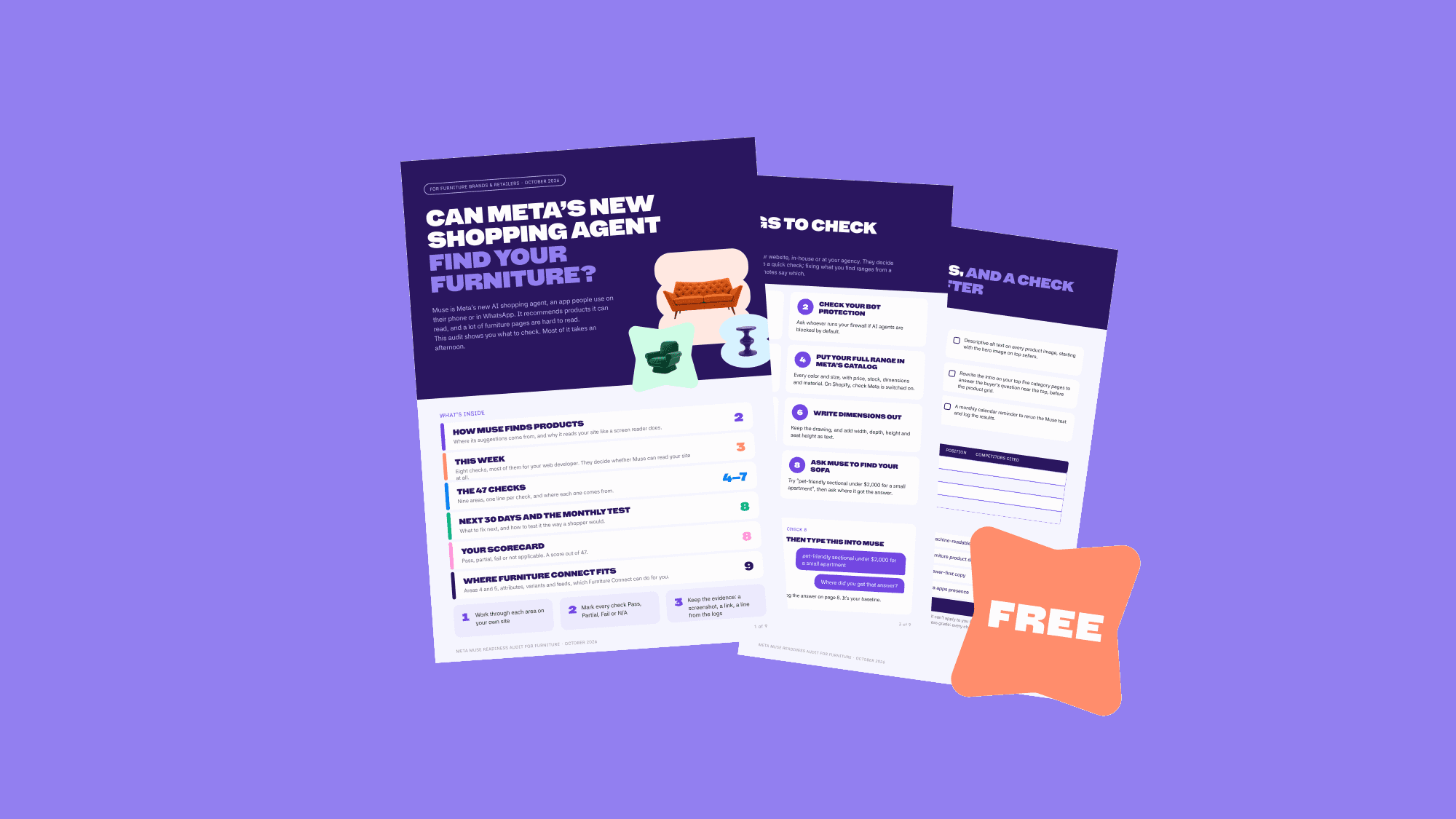
Type a real sofa brief into an AI assistant and note which brands it names. A ten-minute test for furniture ecommerce leads, and what to check on your own pages after.

Open whichever AI assistant you have on your phone and type the kind of thing a shopper types: "I need a sofa under 80 inches wide that seats three, in a performance fabric, under $2,000, ships to Ohio." Read the answer. Then ask yourself one question: is your range in it?
Several things go into an assistant's answer, and most of them you cannot see. One you can check is whether it could find the facts about your products, in a form it could use, at the moment it was asked.
The test, properly
Do it with five requests, not one, and write down what comes back. Mix them:
- A dimensional request: "a sectional that fits a 10 by 12 living room with the door on the long wall".
- A material request: "a leather sofa that's actually full-grain, not bonded".
- A use request: "a sofa that holds up to two dogs and a toddler".
- A comparison: "compare the [your sofa name] with the [competitor's sofa name]".
- A direct one: "tell me about the [your sofa name] from [your brand]".
Use more than one assistant if you can. Note which products it names, which brands, and, for the direct questions about your own range, what it gets right, what it gets wrong, and what it says it can't find.
That last one is the useful column. "I couldn't find the seat depth" or "the listing doesn't specify the fabric content" flags information the assistant did not supply; check the published sources before diagnosing the gap.
What often comes back
Here are a few things worth checking against your own pages. None proves why an assistant chose what it chose.
Start with whether the products named have dimensions, materials, weight capacity and shipping details as plain text or in a product feed. Then compare that with products whose facts sit only in a spec-sheet image, a downloadable PDF or content fetched after a click. The difference does not explain the recommendation on its own, but it shows you which facts were easier to retrieve.
It answers the direct question about your sofa from whatever it could read, and fills gaps with hedges. "The listing shows an overall width of 84 inches but doesn't give the seat height" is a typical line. If your seat height is in the image, you've just been described as not having one.
For the comparison, it compares what it has. If the competitor's page lists frame construction and yours doesn't, the comparison leans on frame construction and you're likely to come off worse by omission.
And it rarely says "this brand is bad". It just doesn't say the brand.
Why this matters more than it did
Search engines usually return links for the shopper to investigate. An assistant may instead give a short answer with a few products and reasons. Shoppers can ask for more, and assistants make trade-offs and mistakes, but appearing in the initial answer can matter.
This doesn't need a prediction about how big AI shopping gets. The test above tells you where you stand today, and a short list of products is a different competitive shape from a page of links whether the share is small or large.
What's being read
An assistant's answer can draw on the shopper's context, price, availability, reviews, third-party coverage, product imagery and the product facts it can find. You can't see or change most of that from a product page. The part you can check and change is the facts: dimensions, materials, construction, capacity, lead time, price, availability, and the answers to the questions real shoppers ask (does it come apart to get through a door, how is the fabric cared for, how deep is the seat).
Those facts exist for every product you sell. Your buyers know them, your supplier's spec sheet has them, your customer service team answers them daily. The question is whether they exist where a machine can read them: as text on the page, as structured fields in a feed, as attributes in your catalog that flow to both. For many furniture retailers they exist in a PDF, a photo of a spec table, and a colleague's head.
That is the gap this series is about, and it's a product data gap before it's a marketing one. For the full argument, see being found by AI.
What to do with the results
Keep the notes. They're your baseline, and they're specific: this product, this question, this missing fact. When you've fixed something, run the same five requests again. For the next step, a side-by-side of your page and the competitor's on the questions the shopper asked, see what the AI found on your competitor's page that it didn't find on yours.
The one-line version for your Monday meeting
"I asked an AI for a sofa like ours and it named three brands. We weren't one, and when I asked about ours directly it couldn't find the seat depth." That sentence usually gets the room's attention faster than a slide about AI.