The Dimensions Problem: mm, cm, Inches, Assembled and Boxed
Why furniture dimensions can go wrong on a listing: mixed units in the supplier file, assembled vs packed sizes, multi-box products, and what channels actually ask for.
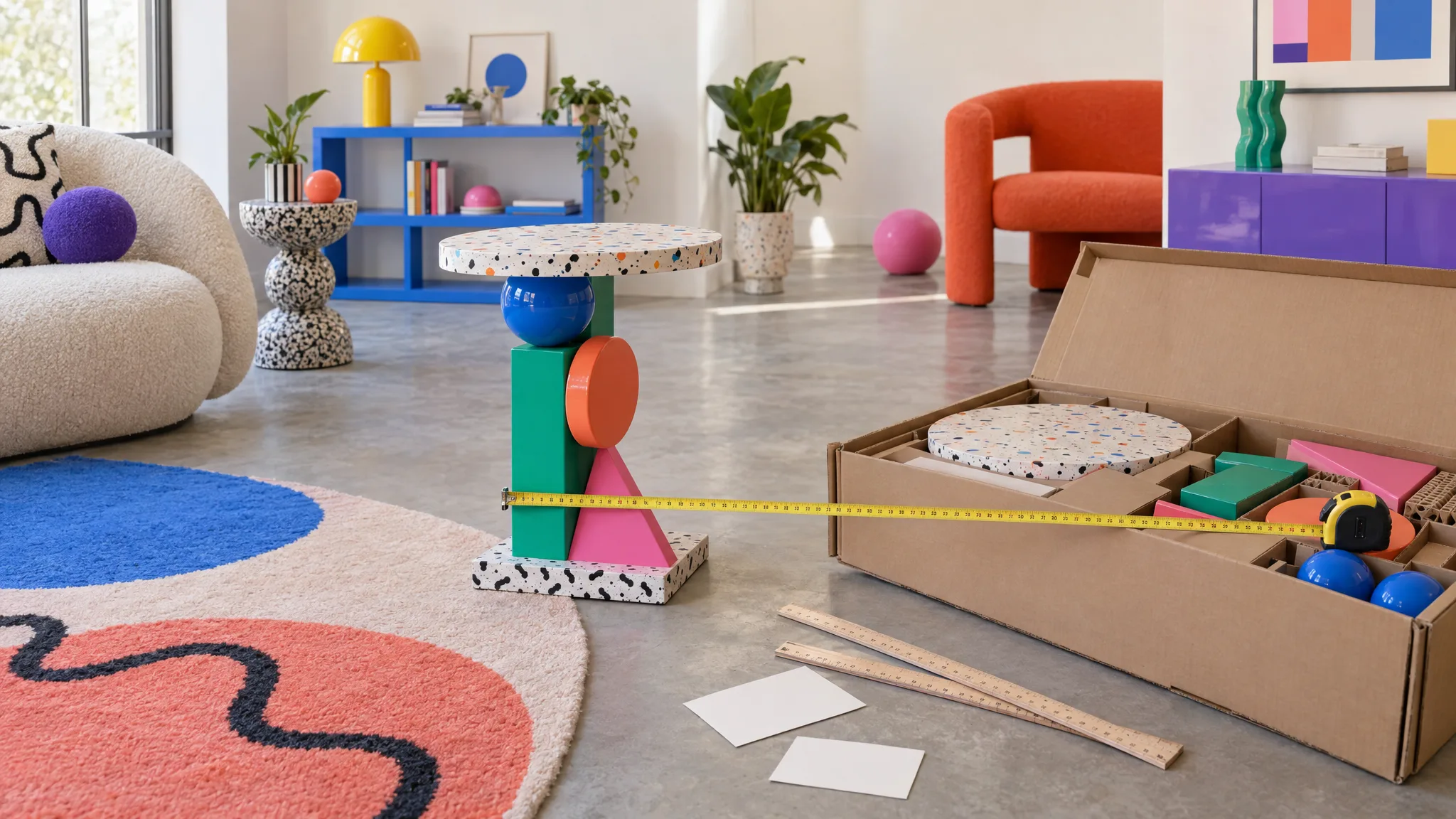
Dimensions are a field every furniture listing has to get right. Customers measure their room. Delivery companies measure their vans. Marketplaces measure their templates. And the supplier's file gives you one set of numbers, in one unit, for one meaning of "size", with a couple missing.
The unit problem
A supplier price list may say "all dims in mm unless stated" in its title block, then mix cells that say "920mm" with cells that say "920". Your website may display centimeters while another destination expects inches. Somewhere, the same measurement has to be interpreted and converted.
The failure isn't the arithmetic. It's that the unit lives in a header note rather than in each value, so a cell containing "920" has no unit of its own. Copy that column into a template expecting centimeters and the sofa becomes 9.2 meters wide.
The meaning problem
"W 920, D 880, H 760" describes the assembled chair. A customer checking whether it fits under the table needs that. Someone planning delivery may also need packed dimensions, carton count and weight. Some retailer templates ask for those logistics fields, but the exact requirements differ by destination and category.
The supplier's price list has the first set. Assembled dimensions sell the product, so that's what buyers get. Packed and carton dimensions live in a different document, if they exist at all, usually a logistics sheet the buyer never asked for.
The multi-box problem
A dining table ships as a top and a base. A bed ships as a headboard, a footboard, two rails and a slat pack. A modular sofa ships as however many sections were ordered. Each carton has its own dimensions and weight, and some channels want each one listed. Check the destination's current template for carton count, the number of supported packed parts, units and required measurements.
A product record that has one "dimensions" field cannot hold this. It needs per-box packaging data, kept separate from the assembled size, so that the table's 180 x 90 x 75 cm doesn't get confused with the top's carton at 190 x 100 x 12 cm.
Furniture Connect's Next channel checks products against its configured requirements before export [1]; carton details are the kind of field that tends to be missing when the only source was a price list.
What it costs when it's wrong
Wrong dimensions can cause several problems. A sofa that doesn't fit through the intended route may be returned. A table listed with its carton dimensions can look very different from what the customer expected. A retailer template that requires packed dimensions may also remain incomplete until someone finds the numbers.
There's a quieter cost too: a blank dimension in the supplier file means a product that waits until someone chases it.
What a complete dimensions record looks like
Assembled width, depth and height, in a known unit, converted on display rather than retyped. Seat height and arm height where the category needs them. Weight. Then, per carton: what's in it, how many, its dimensions and its weight. That is the data a listing, a courier and a marketplace template all draw from, each taking the part it needs.
In Furniture Connect, a formula column can calculate a converted value from the supplier's measurement in an eligible catalog field [2]. The team still chooses which approved value each destination uses. Packaging data for listings and channel templates is also separate from the warehouse or carrier record and should not be treated as interchangeable without checking it.
What the software should and shouldn't do with dimensions
It should ask about the unit when the file is ambiguous, rather than guessing. Furniture Connect's import assistant asks whether dimensions are in centimeters or inches when that's unclear [3]; a column with "920" and "920mm" mixed is exactly the kind of thing to raise rather than silently normalize.
It should not fill a blank dimension. A depth the supplier didn't give is a depth nobody has, and an AI filling it with a plausible number is how a chair gets listed 5 cm shallower than it is. Keep AI columns away from native dimensions; a missing one should stay missing until someone measures or asks.
For how dimensions fit the rest of the preparation, see getting a new furniture range online.
What to ask the supplier for, before the goods land
Ask for assembled dimensions in a stated unit, packed dimensions and weight per carton where relevant, carton count, and category-specific measurements such as seat and arm height. Requesting them before the range arrives gives the supplier time to resolve the gaps before the listing work depends on them.
For the full picture of what a supplier file contains and lacks, see what's actually in a furniture supplier's price list. For how channel templates use this data, see how to prepare a range for Next, Shopify and B&Q from one catalog.