The Furniture Product Data Model: Fields, Variants, Materials and Compliance
A practical furniture product data model covering identity, variants, dimensions, materials, logistics, compliance, media and governance.
Furniture does not fit comfortably into a generic ecommerce schema.
Width, depth and height are only the start. A sofa may have several configurations, dozens of covers and different fillings. A cabinet needs packaged dimensions and tip-over information. A powered recliner brings electrical data into the same record.
A useful furniture product data model has nine connected layers. The full record should identify the item, explain it, show it accurately, support delivery and hold the evidence needed for the markets where it is sold.
This is a schema guide, not legal advice. Regulatory requirements change and depend on the product, business and market. Confirm them with your compliance lead and the current primary source.
If the data you are modeling arrives from suppliers, read why furniture supplier product data arrives incomplete first. It explains which of these layers are usually missing on arrival.
The model at a glance
| Layer | What it answers |
|---|---|
| Identity and hierarchy | What is this product, family and sellable variant? |
| Commercial | What does it cost, sell for and require operationally? |
| Descriptive content | How should it be explained to a buyer? |
| Dimensions | Will it fit the room, user and route into the home? |
| Materials and construction | What is it made from and how is it built? |
| Variants | Which combinations can be bought? |
| Logistics | How is it packed, delivered and assembled? |
| Compliance and evidence | Which requirements apply, and where is the proof? |
| Media and governance | Which assets represent it, and who approved the record? |
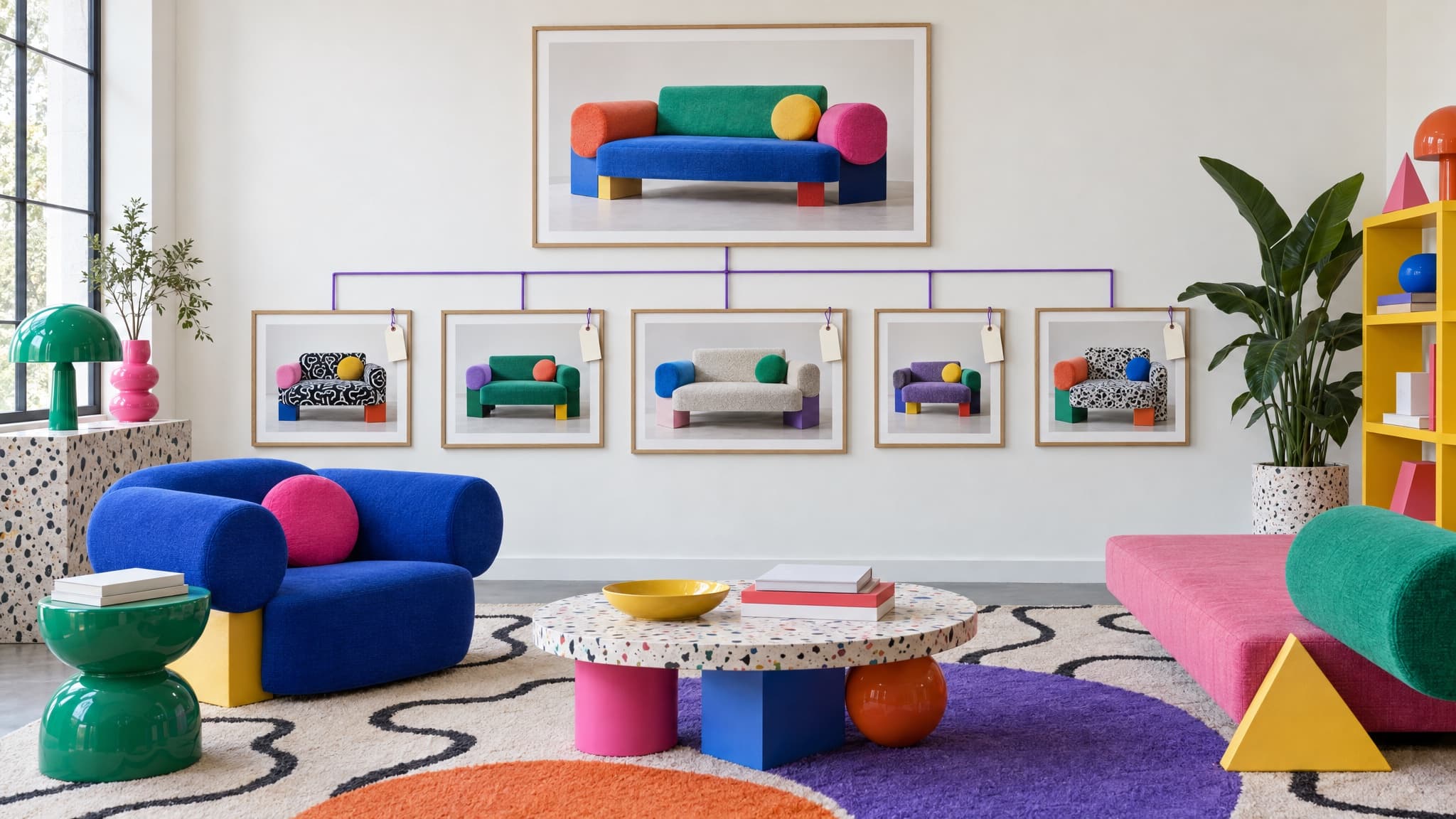
The layers should not be separate spreadsheets. A variant must point to its product family, material records, price, images and relevant documents.
1. Identity and hierarchy
Use four distinct levels:
| Level | Example |
|---|---|
| Collection or range | Hensley |
| Product family | Hensley three-seat sofa |
| Variant | Three-seat sofa, Manolo Blush, oak legs |
| SKU | HEN-3S-MNB-OAK |
Hold your internal SKU, supplier SKU, manufacturer part number, GTIN where used, brand, supplier, product type and country of origin. Add a stable parent or product-group ID so variants can be grouped for channels.
GS1 says each product variation needs its own GTIN.[1] Google likewise expects variants to be submitted separately and grouped with a shared item_group_id.[2]
Do not use an image filename or supplier row number as the permanent identity. Both change too easily.
2. Commercial data
At minimum:
- Cost and currency
- Retail price and currency
- RRP or MSRP, where used
- Promotional price and dates
- Tax class
- Lead time
- Minimum order quantity
- Made-to-order or stocked status
- Discontinued status and date
Keep price at the level where it actually changes. Upholstery may be priced by model, size and cover grade, while a channel may require a final price against every variant. Your source model can hold the logic and produce the channel output without duplicating the whole range by hand.
3. Descriptive content
Store product facts separately from the copy built from them.
Useful content fields include:
- Product name
- Short and long description
- Feature bullets
- Care instructions
- Assembly information
- Warranty terms
- Style and room attributes
- Meta title and description
- Channel-specific title and bullets
The source of truth is not the paragraph. It is the verified data behind it. If copy is drafted with AI, a person should check it against those facts before it is approved. General-purpose assistants such as ChatGPT and Google Gemini can work with product information, but they are not furniture catalogs; see our ChatGPT alternative for furniture product data and Google Gemini alternative for furniture product data pages.
4. Furniture dimensions
Every product needs overall width, depth and height, stored in one canonical unit. Most categories need more.
Seating
- Seat height, width and depth
- Arm height and width
- Back height
- Clearance beneath the frame
- Diagonal depth for access
- Weight capacity
- Number of seats or modular pieces
Tables and storage
- Top thickness and shape
- Leg and knee clearance
- Closed and extended dimensions
- Drawer and internal storage dimensions
- Shelf positions or adjustability
- Weight capacity where relevant
Beds
- Market-specific mattress size
- External frame dimensions
- Headboard height
- Under-bed clearance
- Slat type and spacing
- Maximum mattress depth
Packaging
- Assembled weight
- Number of cartons
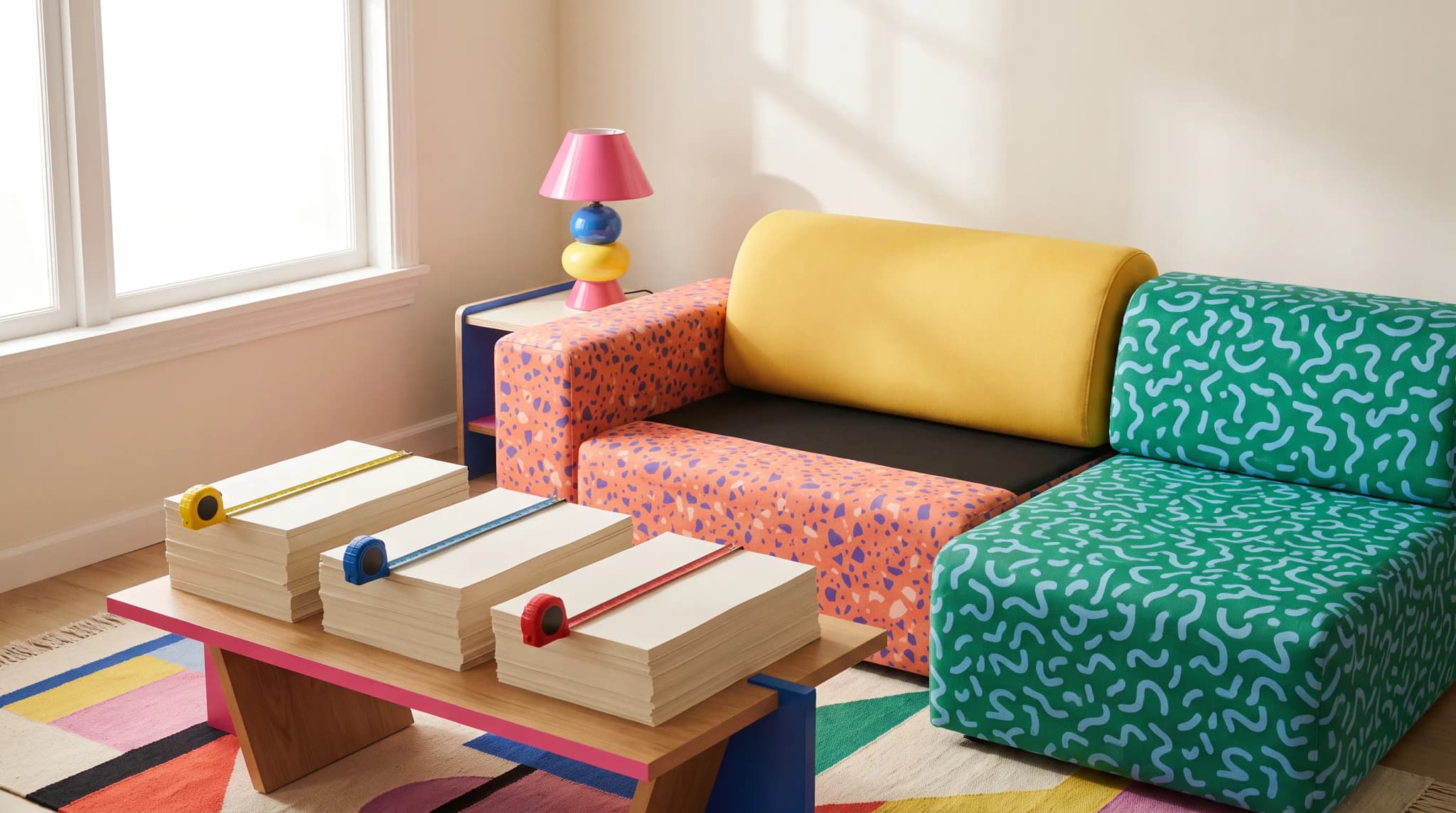
- Dimensions and weight for each carton
Keep assembled and packaged measurements separate. Google, for example, asks merchants to use the actual assembled weight for product_weight and provides separate shipping attributes.[3]
5. Materials and construction
Free-text “fabric sofa” is not enough for filtering, care guidance or regulatory work.
For upholstery, hold the cover type, fiber composition, grade, colorway, material code, wear rating, cleaning instructions and whether covers are removable. For the structure, hold the frame material, timber species or engineered board type, suspension, filling and density where relevant. For case goods, add the surface material, core material, finish, hardware and glass or stone details.
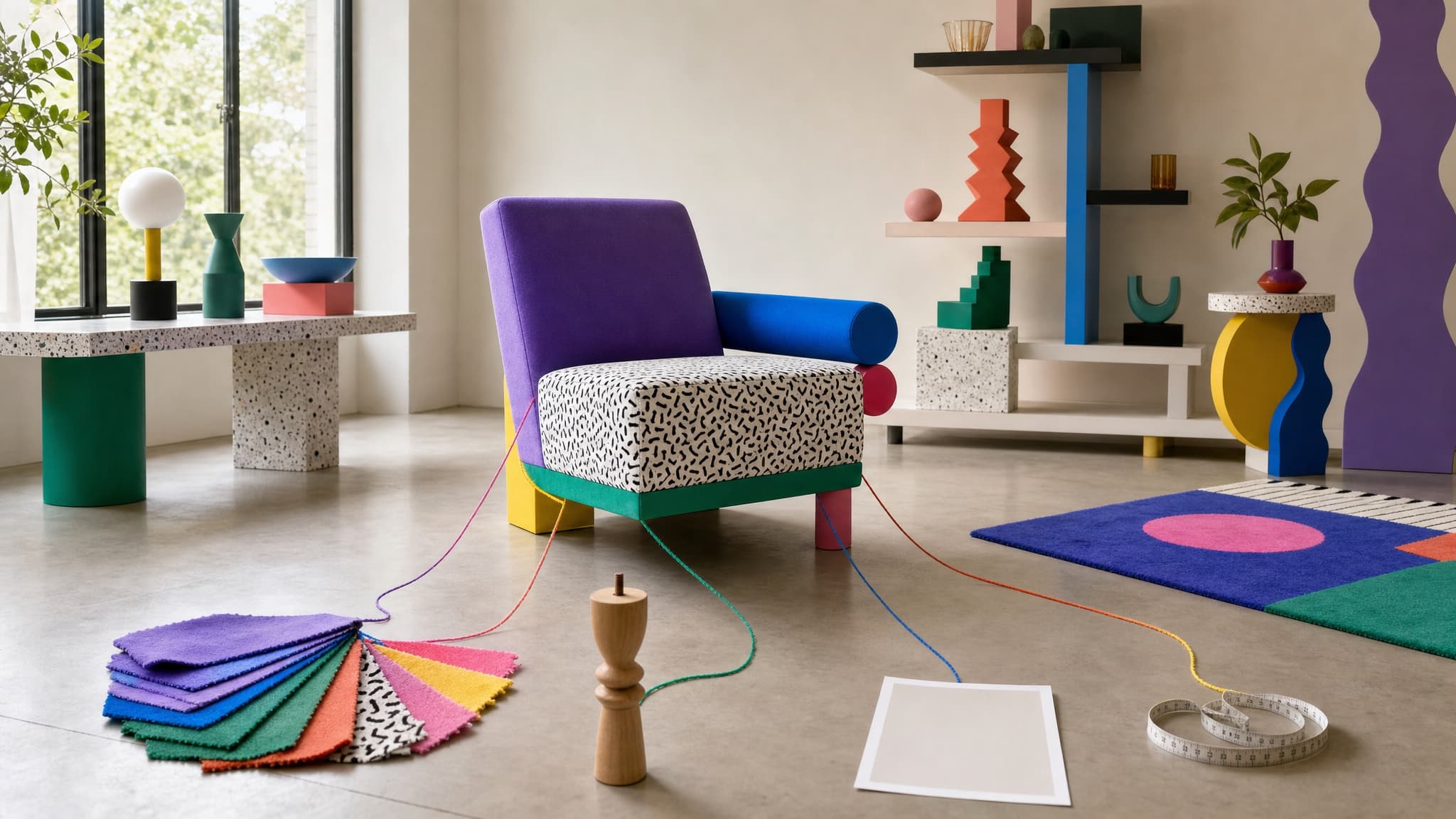
Link repeated fabrics and finishes to a material library. One material record can then support every product using it, including composition, care information and the approved swatch.
This also keeps product claims controlled. “Solid oak,” “oak veneer” and “oak effect” are not interchangeable marketing phrases.
6. Variants and options
Common furniture axes include:
- Size or configuration
- Left-hand or right-hand orientation
- Cover type, grade and colorway
- Leg material, finish or height
- Cushion filling
- Headboard, handle or extension option
Hold the complete set in your own product model. Channels can then receive the version they support. Why does every retailer want product data in a different format? covers that reshaping in detail.
Google's product variant structured data supports properties including color, size, material and pattern.[4] That does not cover every furniture choice, so orientation or configuration may need to be represented differently in the channel model. The important thing is not to discard those axes from the source record simply because one destination cannot express them neatly.
For every option, decide whether it creates a SKU, a separate product or an order-time configuration. Record that decision rather than leaving it in a team member's memory. Why configurable furniture is so difficult to quote shows what goes wrong when it stays there.
7. Logistics
Furniture logistics data belongs in the product record because it affects the purchase and the delivery.
Include:
- Carton count, dimensions and weight
- Flat-packed or assembled status
- Assembly required, estimated time, tools and people
- Two-person handling requirement
- Delivery service constraints
- Diagonal depth and other access information
- Piece count for sets and modular products
- Packaging materials and weights where the business needs them for reporting
This is the data that helps a buyer understand whether the item will get through the door and helps the operations team understand what will arrive.
8. Compliance and evidence
Do not model compliance as a single checkbox.
For every record, hold:
- Market and regime
- Document or evidence type
- Issuer or test house
- Reference number
- Issue, expiry or review date
- Covered SKUs, components or batches
- Required label text or label artwork
- Approval status and source file
The product determines which regimes apply. UK upholstered furniture is covered by the Furniture and Furnishings (Fire) (Safety) Regulations.[5] In the US, separate federal rules cover upholstered furniture flammability, clothing storage units and composite wood products used in finished goods.[6][7][8]
The schema should be capable of holding the evidence and its relationship to the product. It should not attempt to replace legal interpretation.
Build evidence collection into furniture supplier catalog onboarding so documents can be connected to the products and variants they cover.
9. Media and governance
Define media by role:
- Hero or cutout
- Product gallery
- Colorway or configuration image
- Lifestyle image
- Material or finish swatch
- Dimension diagram
- Detail or construction image
- Video or 3D model
- Assembly, care and specification documents
Each asset needs a product or variant link, its role, approval status and any channel-specific output details. The furniture asset metadata template sets out those fields, and what is furniture DAM? explains why they belong next to the product record.
Furniture Connect can run imagery jobs across hundreds of SKUs and keep assets connected with catalog records.[9] Generated imagery still requires manual product review. A reviewer should compare it with the approved source and check silhouette, proportions, construction, material, finish and color. After approval, the asset can be linked to the exact SKU or colorway with confirmation.
Channel formatting is a separate decision. If an output needs a square crop, a web banner ratio or a particular resolution, specify it.
Finally, keep governance metadata for the product data itself:
- Source
- Last verified date
- Verified by
- Owner
- Status: missing, provisional, verified or not applicable
- Approval and publish state
Without this, an old value and a recently checked value look identical, which is how customer-service teams end up giving different answers from real sources.
Minimum viable furniture field set
If you are moving away from a basic spreadsheet, start here:
Identity: product family ID, variant SKU, supplier SKU, GTIN, brand, supplier, product type, collection.
Commercial: cost, price, currency, lead time, stocked or made-to-order status.
Product facts: name, features, care, assembly, warranty, overall and category-specific dimensions, materials and construction.
Variants: option names and values, purchasable combinations, variant price, dimensions and availability.
Logistics: assembled weight, carton count, carton dimensions and weights, delivery and assembly requirements.
Compliance: applicable regime, evidence reference, dates, covered products or batches, label details and source document.
Media: asset role, SKU or variant link, approval status and channel output.
Governance: source, owner, verification date and publish status.
That is enough to create a dependable structure. Add fields because a customer, operation, market or channel needs them, not because the software offers another empty column. The product import format maps this field set onto a spreadsheet you can load, and the data quality scorecard checks a range against it.
Frequently asked questions
What fields does a furniture product data model need?
Nine connected layers: identity and hierarchy, commercial data, descriptive content, dimensions, materials and construction, variants, logistics, compliance and evidence, and media and governance. The layers should reference each other rather than live as separate spreadsheets.
How should furniture variants be structured?
Use four levels — collection or range, product family, variant, SKU — and hold every furniture axis in your own model, including the ones a given channel can't express. Size, orientation, cover grade, colorway, leg finish and cushion filling all belong in the source record even when a feed only supports color, size, material and pattern.
Which dimensions does a furniture listing actually need?
Overall width, depth and height in one canonical unit, plus category-specific measurements: seat height and diagonal depth for seating, closed and extended sizes for tables, under-bed clearance and maximum mattress depth for beds. Keep packaging measurements separate from assembled ones.
How should compliance be modeled in a furniture catalog?
Not as a checkbox. Hold the market and regime, document type, issuer, reference number, dates, the SKUs or batches covered, required label text and the source file — and allow “not applicable” as a status distinct from “missing.” The schema holds the evidence and its relationship to the product; it doesn't replace legal interpretation.
Sources
- GS1: How many GTINs are needed for products with multiple sizes and colors?
- Google Merchant Center: Item group ID for product variants
- Google Merchant Center: Product data specification
- Google Search Central: Product variant structured data
- UK legislation: Furniture and Furnishings (Fire) (Safety) Regulations 1988
- US CPSC: Flammable Fabrics Act guidance, including upholstered furniture
- US CPSC: Clothing storage unit requirements
- US EPA: Formaldehyde standards for composite wood products
- Furniture Connect: AI for furniture at catalog scale
Furniture Connect brings supplier data, products, variants and approved assets into one catalog built for furniture. Book a demo and bring a range you want to put through it.